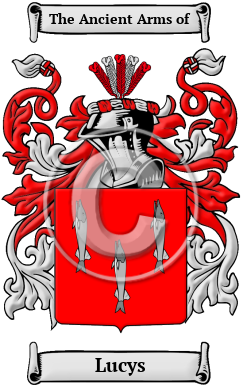
| ![Show Contents]() Lucys History, Family Crest & Coats of Arms Lucys History, Family Crest & Coats of Arms
Etymology of LucysWhat does the name Lucys mean? Lucys is a name of ancient Norman origin. It arrived in England with the Norman Conquest of 1066. The Lucys family lived in Norfolk. Their name, however, derives from the family's place of residence prior to the Norman Conquest of 1066 of England, Lucy, near Rouen. 1 Luce is in Orne in the bailiwick of le Passeis, near Domfront, Normandy. Early Origins of the Lucys familyThe surname Lucys was first found in Norfolk where the first mention of the family of Lucy was made by Henry I of the lordship of Dice therein to Richard de Lucie, Governor of Falaise who later played a prominent role in the contests of King Stephen's reign. He was more than once Lieutenant of England. 2 "In 1165, Richard de Lucy's barony in Passy ([, Normandy]) consisted of 19 fees. He also held 19 in Devon, besides others in Kent, Norfolk, Suffolk and in 1156 in Northumberland. Geoffry de Lucy held on fee in Devon in 1165." 3 Inglewood Forest in Cumberland was home to another branch of the family. "It was a forest only in the Scottish sense of the word; a wild open chace, 'full of woods, red and fallow deer, wild swine, and all manner of wild beasts.' The wild beasts included many wolves. There is a sad tradition respecting a lady of the Lucy family, who, walking one evening near her father's castle of Egremont, was attacked and torn to pieces by a famished wolf. The place where her mangled body was found is still marked by a cairn of stones, and known as Woeful Bank." 4 The Lucys of Charlecote, Warwickshire descend from Sir William de Charlecote who changed his name to Lucy. This latter claim of a name change is of some dispute but what is certain is that this was the same gentleman that Shakespeare apparently lampooned in the 1580s by mocking his name and suggesting his wife was unfaithful. Again, this claim cannot be verified. Truro in Cornwall was an ancient home to some of the family. "The manor, in 1161, belonged to Richard de Luci, chief justice of England and lord of Truro, who probably built the castle (the site of which is still called Castle Hill), and who invested the inhabitants with numerous privileges, which were confirmed by Reginald Fitz-Henry, Earl of Cornwall, natural son of Henry I." 5 Another branch of the family was found at Lessness in Kent. It was here that Richard de Luci (1089-1179) of Richard de Lucy was High Sheriff of Essex and later Chief Justiciar of England (1154-1179.) He also founded "an abbey for Black canons, in honour of St. Mary and St. Thomas the Martyr in 1178." 5 Early History of the Lucys familyThis web page shows only a small excerpt of our Lucys research. Another 90 words (6 lines of text) covering the years 1400, 1525, 1551, 1585, 1592, 1594, 1614, 1619, 1640, 1647, 1653, 1658, 1660, 1667 and 1677 are included under the topic Early Lucys History in all our PDF Extended History products and printed products wherever possible. Lucys Spelling VariationsEndless spelling variations are a prevailing characteristic of Norman surnames. Old and Middle English lacked any definite spelling rules, and the introduction of Norman French added an unfamiliar ingredient to the English linguistic stew. French and Latin, the languages of the court, also influenced spellings. Finally, Medieval scribes generally spelled words according to how they sounded, so one person was often referred to by different spellings in different documents. The name has been spelled Lucy, Luce, Lucey, Lucie and others. Early Notables of the Lucys familyWilliam Lucy,High Sheriff of Herefordshire in 1400; Sir Richard Lucy, 1st Baronet (c.1592-1667), an English politician who sat in the House of Commons between 1647 and 1658; William Lucy (1594-1677), an English clergyman, Bishop of St David's (1660-1677); Sir Thomas Lucy (d.1525); and his son, William Lucy (d.1551) of Charlecote near Stratford-on-Avon, Warwickshire; and his son...
Another 55 words (4 lines of text) are included under the topic Early Lucys Notables in all our PDF Extended History products and printed products wherever possible. Migration of the Lucys family to IrelandSome of the Lucys family moved to Ireland, but this topic is not covered in this excerpt. More information about their life in Ireland is included in all our PDF Extended History products and printed products wherever possible. Migration of the Lucys familyTo escape the political and religious persecution within England at the time, many English families left for the various British colonies abroad. The voyage was extremely difficult, though, and the cramped, dank ships caused many to arrive in the New World diseased and starving. But for those who made it, the trip was most often worth it. Many of the families who arrived went on to make valuable contributions to the emerging nations of Canada and the United States. An inquiry into the early roots of North American families reveals a number of immigrants bearing the name Lucys or a variant listed above: Anthony and John Lucey settled in Philadelphia in 1838; John Lucy settled in Virginia in 1653 along with Margaret; Hester Lucye settled in Virginia in 1654.
- Cleveland, Dutchess of The Battle Abbey Roll with some Account of the Norman Lineages. London: John Murray, Abermarle Street, 1889. Print. Volume 2 of 3
- Burke, John Bernard, The Roll of Battle Abbey. London: Edward Churton, 26, Holles Street, 1848, Print.
- The Norman People and Their Existing Descendants in the British Dominions and the United States Of America. Baltimore: Genealogical Publishing, 1975. Print. (ISBN 0-8063-0636-X)
- Cleveland, Dutchess of The Battle Abbey Roll with some Account of the Norman Lineages. London: John Murray, Abermarle Street, 1889. Print. Volume 3 of 3
- Lewis, Samuel, A Topographical Dictionary of England. Institute of Historical Research, 1848, Print.
 |