
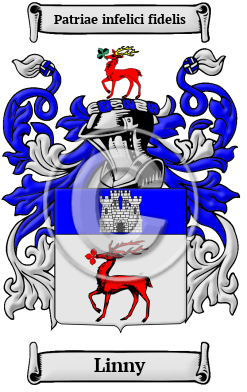
Show ContentsLinny History, Family Crest & Coats of Arms

Etymology of Linny

What does the name Linny mean?

The Irish surnames in use today are underpinned by a multitude of rich histories. The name Linny originally appeared in Gaelic as Ó Luinigh.

Early Origins of the Linny family

The surname Linny was first found in County Tyrone (Irish: Tír Eoghain), the ancient territory of the O'Neills, now in the Province of Ulster, central Northern Ireland, where they held a family seat from ancient times.

Early History of the Linny family

This web page shows only a small excerpt of our Linny research. Another 61 words (4 lines of text) are included under the topic Early Linny History in all our PDF Extended History products and printed products wherever possible.

Linny Spelling Variations

During the Middle Ages, a standardized literary language known by the general population of Ireland was a thing of fiction. When a person's name was recorded by one of the few literate scribes, it was up that particular scribe to decide how to spell an individual's name. So a person could have several spelling variations of his name recorded during a single lifetime. Research into the name Linny revealed many variations, including Lunney, Lunnie, Looney, Loney, Lunny and many more.

Early Notables of the Linny family

More information is included under the topic Early Linny Notables in all our PDF Extended History products and printed products wherever possible.


Linny migration to the United States +

Ireland saw an enormous decrease in its population in the 19th century due to immigration and death. This pattern of immigration began slowly in the late 18th century and gradually grew throughout the early portion of the 19th century. However, a dramatic increase in the country's immigration numbers occurred when the Great Potato Famine struck in the 1840s. The early immigrants to North America were primarily destined to be farmers tending to their own plot of land, those that came later initially settled within pre-established urban centers. These urban immigrants provided the cheap labor that the fast developing United States and soon to be Canada required. Regardless of their new lifestyle in North America, the Irish immigrants to the United States and Canada made invaluable contributions to their newly adopted societies. An investigation of immigrant and passenger lists revealed many Linnys:

Linny Settlers in United States in the 17th Century
  • Anne Linny, who landed in Virginia in 1653 1
  • Henry Linny, who arrived in Virginia in 1661 1


The Linny Motto +

The motto was originally a war cry or slogan. Mottoes first began to be shown with arms in the 14th and 15th centuries, but were not in general use until the 17th century. Thus the oldest coats of arms generally do not include a motto. Mottoes seldom form part of the grant of arms: Under most heraldic authorities, a motto is an optional component of the coat of arms, and can be added to or changed at will; many families have chosen not to display a motto.

Motto: Patriae infelici fidelis
Motto Translation: Faithful to an unhappy country.


  1. Filby, P. William, Meyer, Mary K., Passenger and immigration lists index : a guide to published arrival records of about 500,000 passengers who came to the United States and Canada in the seventeenth, eighteenth, and nineteenth centuries. 1982-1985 Cumulated Supplements in Four Volumes Detroit, Mich. : Gale Research Co., 1985, Print (ISBN 0-8103-1795-8)


Houseofnames.com on Facebook