| ![Show Contents]() Likey History, Family Crest & Coats of Arms Likey History, Family Crest & Coats of Arms
Etymology of LikeyWhat does the name Likey mean? Among the all the peoples of ancient Scotland, the first to use the name Likey were the Strathclyde-Britons. It was a name for someone who lived in the village of Logie in Fifeshire. "This parish derives its name from the situation of its church in a hollow surrounded by hills, of which that term in the Gaelic language is descriptive. Logie derives its name from the Gaelic word lag or laggie, denoting "low or flat ground," the lands consisting principally of an extensive tract of perfectly level country. " 1 Early Origins of the Likey familyThe surname Likey was first found in Fife where "Master John de Logy, canon of Dunkeld, appears in 1271. William de Logyn and Malise de Logins were Scots prisoners of war taken at Dunbar, 1296. Wauter de Logy of Fife rendered homage, 1296. The earliest notice of the family of Logy of Logy is in 1320, when Sir John of Logy is mentioned as one of the conspirators against Robert the Bruce. " 2 The year 1296 was a very turbulent time in Scotland. It was the year that King Edward I of England invaded and those who "rendered homage" to Edward were able to retain their lands, while those who did not were either killed or lost them. Early History of the Likey familyThis web page shows only a small excerpt of our Likey research. Another 180 words (13 lines of text) covering the years 1321, 1328, 1396, 1405, 1424, 1457, 1700, 1765 and 1890 are included under the topic Early Likey History in all our PDF Extended History products and printed products wherever possible. Likey Spelling VariationsThe variation in the spelling of Medieval names is a result of the lack of spelling rules in the English language prior to the last few hundred years. Before that time, scribes spelled according to sound, often varying the spelling of name within a single document. Likey has appeared as Logie, Loggie, Logy, Logue and others. Early Notables of the Likey familyMore information is included under the topic Early Likey Notables in all our PDF Extended History products and printed products wherever possible. Migration of the Likey family to IrelandSome of the Likey family moved to Ireland, but this topic is not covered in this excerpt.
Another 60 words (4 lines of text) about their life in Ireland is included in all our PDF Extended History products and printed products wherever possible. Migration of the Likey familyAs the persecution of Clan families continued, they sailed for North America in increasing numbers. In most cases, they found the freedom and opportunity they sought. Land was often available and the American War of Independence allowed Scots an opportunity to solidify their independence from the English crown. These settlers and their ancestors went on to play essential roles in the forging of the nations of the United States and Canada. Among them: Captain Logie who settled in Boston Massachusetts in 1765 and about the same time Andrew Logie settled in Georgia; John and Samuel Logue settled in Charles Town [Charleston], South Carolina in 1772.
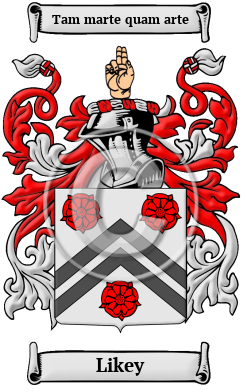
The motto was originally a war cry or slogan. Mottoes first began to be shown with arms in the 14th and 15th centuries, but were not in general use until the 17th century. Thus the oldest coats of arms generally do not include a motto. Mottoes seldom form part of the grant of arms: Under most heraldic authorities, a motto is an optional component of the coat of arms, and can be added to or changed at will; many families have chosen not to display a motto.
Motto: Tam marte quam arte
Motto Translation: As much by strength as by art.
- Lewis, Samuel, A Topographical Dictionary of Scotland. Institute of Historical Research, 1848, Print.
- Black, George F., The Surnames of Scotland Their Origin, Meaning and History. New York: New York Public Library, 1946. Print. (ISBN 0-87104-172-3)
 |