| ![Show Contents]() Lessie History, Family Crest & Coats of Arms Lessie History, Family Crest & Coats of Arms
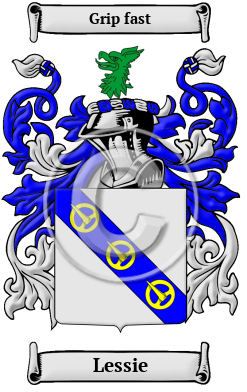
Etymology of LessieWhat does the name Lessie mean? The Lessie family name was first used by descendants of the Pictish people of ancient Scotland. It is a name for someone who lived in the barony of Leslie in the county of Aberdeen. The surname Lessie belongs to the category of habitation names, which are derived from pre-existing names for towns, villages, parishes, or farmsteads. Lessie Coat of Arms CreationThe Earl of Rothes is now the head of the Leslies, and his crest is a demi-griffin--a fanciful crest-which, according to some authorities, means wisdom joined to fortitude. In the coat of arms there are three buckles for Leslie, and one wonders whether they were put there in memory of the buckles on Queen Margaret's girdle when Bartholomew Leslie saved her in the following circumstances. In crossing a river swollen by floods the Queen was thrown from her horse and was in danger of being carried away and drowned, when the brave Bartholomew plunged into the stream, seized her Majesty by the girdle, and, as he with difficulty was bringing her to the bank, she kept on exclaiming " Grip fast," and afterwards expressed a wish that her preserver should retain the words as a motto in remembrance of his brave action, and " Grip fast " has been the motto of Leslie ever since. 1 Early Origins of the Lessie familyThe surname Lessie was first found in Aberdeenshire (Gaelic: Siorrachd Obar Dheathain), a historic county, and present day Council Area of Aberdeen, located in the Grampian region of northeastern Scotland, where they were recorded as a family of great antiquity seated on the lands of Leslie. "This place is said to have derived its name from a family who held the lands so early as the eleventh century." 2 It is generally believed the family was descended from Bartholomew Leslyn, son of Walter de Leslyn, a Flemish knight who attended Queen Margaret when she arrived to marry King Malcolm of Scotland in 1067. 3 4 According to legend, the wife of King Malcolm III was thrown from her horse while crossing a river and nearly drowned, but Leslyn, gripping the horses bridle, saved her. She frequently cautioned him to 'grip fast' and afterwards commanded that he retain those words as his family motto. He later married the sister of Malcolm Ceanmore, and so was appointed Governor of Edinburgh Castle and made Lord Leslie. 4 Malcolm Leslie of Garioch in Aberdeenshire, son of Bartolf, received a feudal charter confirming his lands from a grant made to his name-father, Lord Leslie. Malcolm's grandson, Sir Andrew de Lesly, was one of the signatories of the 1320 'Arbroath Declaration of Independence' to the Pope, which affirmed Scotland's sovereignty and included the words: "as long as one hundred Scotsmen still live they would never submit to English rule." Another source claims the family "trace their origin to Bartholomew, a Flemish chief, who settled with his followers in the district of Garioch, in Aberdeenshire, in the reign of William the Lion. He took the name of De Lesley from the place where he settled. The heralds, however, have an old legend representing the first man of the family as having acquired distinction and a name at once, by overcoming a knight in battle, at a spot between a less lee (meadow) and a greater." 5 Whichever origin the reader chooses, all agree that one of the first records of the family was "Earl David, brother of William the Lion, granted c. 1171-1199 the lands of Lesslyn in the Garioch to Malcolm son of Bartholf. " 6 As far as the origin of the Coat of Arms is concerned perhaps this quote will shed some light: "Sir Norman de Lechelyn of Aberdeenshire rendered homage in 1296. His seal bears six shields in a circle conjoined in base, each charged with 3 round buckles on a bend." 6 It's a little different that the one anciently used by the family but it is significant in that it notes that the family was using a variant of the same as far back as the 13th century. Early History of the Lessie familyThis web page shows only a small excerpt of our Lessie research. Another 309 words (22 lines of text) covering the years 1340, 1411, 1527, 1562, 1571, 1580, 1596, 1600, 1607, 1635, 1641, 1650, 1661, 1667, 1671, 1680, 1682, 1693, 1711, 1722, 1758, 1797, 1850 and 1890 are included under the topic Early Lessie History in all our PDF Extended History products and printed products wherever possible. Lessie Spelling VariationsScribes in the Middle Ages did not have access to a set of spelling rules. They spelled according to sound, the result was a great number of spelling variations. In various documents, Lessie has been spelled Leslie, Lesley, Lessely, Lessley, Lesslie and others. Early Notables of the Lessie familyJohn Lesley (1527-1596) Scottish bishop, historian, and statesman, ecclesiastical adviser to Mary Queen of Scots; Henry Leslie (1580-1661) Scottish-born, Church of Ireland Bishop of Down and Connor (1635 to 1661) and briefly Bishop of Meath (1661); John Leslie (1571-1671), a Scottish royalist bishop of Clogher, known as the "fighting bishop" for his resistance to the Irish rebellion of 1641 and the parliamentarian forces; and his son, Charles Leslie (1650-1722), an Anglican nonjuring...
Another 71 words (5 lines of text) are included under the topic Early Lessie Notables in all our PDF Extended History products and printed products wherever possible. Migration of the Lessie family to IrelandSome of the Lessie family moved to Ireland, but this topic is not covered in this excerpt.
Another 86 words (6 lines of text) about their life in Ireland is included in all our PDF Extended History products and printed products wherever possible. Migration of the Lessie familyThe cruelties suffered under the new government forced many to leave their ancient homeland for the freedom of the North American colonies. Those who arrived safely found land, freedom, and opportunity for the taking. These hardy settlers gave their strength and perseverance to the young nations that would become the United States and Canada. Immigration and passenger lists have shown many early immigrants bearing the name Lessie: Nicholas Lesley, who settled in Virginia in 1650; Margaret Leslie settled in New Jersey in 1685; John Leslie settled in the Barbadoes in 1678 with his son.
The motto was originally a war cry or slogan. Mottoes first began to be shown with arms in the 14th and 15th centuries, but were not in general use until the 17th century. Thus the oldest coats of arms generally do not include a motto. Mottoes seldom form part of the grant of arms: Under most heraldic authorities, a motto is an optional component of the coat of arms, and can be added to or changed at will; many families have chosen not to display a motto.
Motto: Grip fast
- Polson, Alexander, The Romance of Scottish Crests and Mottoes. Inverness: Walter Alexander, Inglis Street 1929. Print
- Lewis, Samuel, A Topographical Dictionary of Scotland. Institute of Historical Research, 1848, Print.
- Harrison, Henry, Surnames of the United Kingdom: A Concise Etymological Dictionary Baltimore: Geneological Publishing Company, 2013. Print
- Sims, Clifford Stanley The Origin and Signification of Scottish Surnames. 1862. Print.
- Lower, Mark Anthony, Patronymica Britannica, A Dictionary of Family Names of the United Kingdom. London: John Russel Smith, 1860. Print.
- Black, George F., The Surnames of Scotland Their Origin, Meaning and History. New York: New York Public Library, 1946. Print. (ISBN 0-87104-172-3)
 |