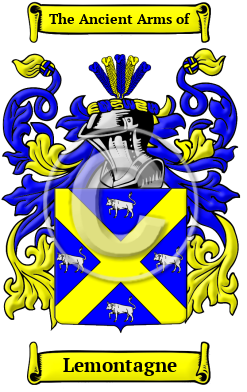
| ![Show Contents]() Lemontagne History, Family Crest & Coats of Arms Lemontagne History, Family Crest & Coats of Arms
- Origins Available:
France
Etymology of LemontagneWhat does the name Lemontagne mean? The history of the Lemontagne family goes back to the Medieval landscape of southern France, to a region known as Languedoc. It is derived from the family living on or near a hill. The surname could be translated as "dweller on the hill." Further research revealed that the name is derived from the Old French word "montaine," which means "hill." Early Origins of the Lemontagne familyThe surname Lemontagne was first found in Languedoc in south-east France where they were distinguished members of the aristocracy, and held a family seat at Montiver. They were also in Moulines and at Poncins in Forez. This family also changed their name in Holland to Van den Bergh, where they held lands. The Moulines branch moved to Velay and preferred the spelling Montagnat. This latter branch established estates in Lyonnais to the east of Languedoc. By the 16th century the title of the Montaigne had passed to the family of Eyquem in Perigord. Michel Eyquem, Seigneur de Montaigne, 1533-1592, was a writer, moralist, and councillor of Parliament in Bordeaux, he was born at Castle Montaigne and died there. François Lamontagne, son of Renaud and Jeanne, travelled from France to Canada in the 17th century. After arriving in Quebec he married Anne Philippe, daughter of Jacques and Anne, on 24th November 1671. They remained together in the province of Quebec until François passed away at the age of 65 on 10th April 1701. 1 Early History of the Lemontagne familyThis web page shows only a small excerpt of our Lemontagne research. Another 30 words (2 lines of text) covering the years 1533 and 1592 are included under the topic Early Lemontagne History in all our PDF Extended History products and printed products wherever possible. Lemontagne Spelling VariationsThroughout the course of history most surnames have undergone changes for many reasons. During the early development of the French language, a son and father may not have chosen to spell their name the same way. Many are simple spelling changes by a person who gave his name, phonetically, to a scribe, priest, or recorder. Many names held prefixes or suffixes which became optional as they passed through the centuries, or were adopted by different branches to signify either a political or religious adherence. Hence, we have many spelling variations of this name, Lemontagne some of which are Montaigne, Montaign, Montagne, Montagnat, Mountain, Lamontaigne, Lamontagne and many more. Early Notables of the Lemontagne familyMore information is included under the topic Early Lemontagne Notables in all our PDF Extended History products and printed products wherever possible. Migration of the Lemontagne familyIn 1643, 109 years after the first landings by Cartier, there were only about 300 people in Quebec, in 1663 there were only 500, 2,000 migrants arrived during the next decade. Early marriage was desperately encouraged amongst the immigrants. Youths of 18 took fourteen-year-old girls for their wives. The fur trade was developed and attracted migrants, both noble and commoner from France. 15,000 explorers left Montreal in the late 17th and 18th centuries. Migration from France to New France or Quebec as it was now more popularly called, continued from France until it fell in 1759. By 1675, there were 7000 French in Quebec. By the same year the Acadian presence in Nova Scotia, New Brunswick and Prince Edward Island had reached 500. In 1755, 10,000 French Acadians refused to take an oath of allegiance to England and were deported to Louisiana. Meanwhile, in Quebec, the French race flourished, founding in Lower Canada, one of the two great solitudes which became Canada. Many distinguished contributions have been made by members of this family name Lemontagne. It has been prominent in the arts, religion, politics and culture in France and New France. Amongst the settlers in North America with this distinguished name Lemontagne were Mr. Lamontaigne who settled in Louisiana in 1719; Charles Lamontaigne arrived in Quebec from Ile-de-France in 1749; Nicholas De La Montagne settled in Maryland in 1670..
- Olivier, Reginald L. Your Ancient Canadian Family Ties. Logan: The Everton Publishers, Inc., P.O. Box 368, 1972. Print
 |