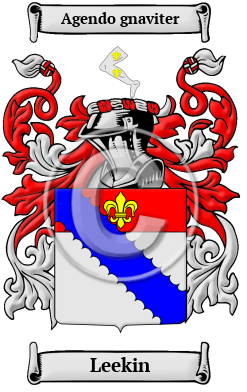
| ![Show Contents]() Leekin History, Family Crest & Coats of Arms Leekin History, Family Crest & Coats of Arms
Etymology of LeekinWhat does the name Leekin mean? The ancestors of the bearers of the Leekin family name are thought have lived in ancient Anglo-Saxon England. They were first found in one of the places that was called Leake. The name literally means "place at the brook," from the Scandinavian word "loekr." The Lincolnshire, Yorkshire or Nottinghamshire parishes all date back to the Domesday Book of 1086 1 where they were listed as Leche, Lec(h)e and Lec(c)he respectively. 2 Early Origins of the Leekin familyThe surname Leekin was first found in either Lincolnshire, Yorkshire or Nottinghamshire which all have parishes names Leake. For some of the first listings of the family, we must look to Lincolnshire where the Hundredorum Rolls of 1273 list the following: John de Lek; Roger de Leke; and Teobald de Lek as all living in that shire at that time. 3 Willie's Lyke-Wake is a Child Ballad, one of 305 traditional ballads from England and Scotland, and their American variants listed in the 1904 Houghton Mifflin edition. Lyke-Wake Dirge is a traditional English song that is thought to have originated in the Yorkshire area. Other early rolls included the following entries for the family: Walter de Lek in the Assize Rolls for Lincolnshire in 1202; Ralph de Lek in the Assize Rolls for Yorkshire in 1219; Henry de Leek in the Assize Rolls for Cheshire in 1290; John Leke in Lincolnshire (no date); and Ralph Leecke in the Hundredorum Rolls for Bedfordshire in 1279. 4 Early History of the Leekin familyThis web page shows only a small excerpt of our Leekin research. Another 64 words (5 lines of text) covering the years 1334, 1581, 1627, 1633, 1655, 1656, 1660, 1679, 1681, 1708, 1710, 1712, 1715 and 1720 are included under the topic Early Leekin History in all our PDF Extended History products and printed products wherever possible. Leekin Spelling VariationsUntil quite recently, the English language has lacked a definite system of spelling rules. Consequently, Anglo-Saxon surnames are characterized by a multitude of spelling variations. Changes in Anglo-Saxon names were influenced by the evolution of the English language, as it incorporated elements of French, Latin, and other languages. Although Medieval scribes and church officials recorded names as they sounded, so it is common to find one person referred to by several different spellings of his surname, even the most literate people varied the spelling of their own names. Variations of the name Leekin include Leake, Leak, Leek, Leeke, Leyke and others. Early Notables of the Leekin familyFrancis Leke, 1st Earl of Scarsdale (1581-1655) fought for the Royalist cause in the English Civil War; Sir Francis Leke, 1st Baronet (1627-1679), an English soldier, administrator and Member of Parliament, High Sheriff of Nottinghamshire for 1660; William Leake, the father (died 1633) and his son (died 1681), London publishers...
Another 49 words (4 lines of text) are included under the topic Early Leekin Notables in all our PDF Extended History products and printed products wherever possible.
| Leekin migration to Australia | + |
Emigration to Australia included the Second Fleet of convicts, tradespeople and early settlers. Early immigrants include: Second Fleet - Mr. James Leekin, (Seekin, Setkin, Seken), (b. 1769), aged 21, British settler convicted in Middlesex, England in 1789, sentenced to 7 years for stealing clothes, transported aboard the ship "Active" leaving in 1790 arriving in New South Wales, Australia in 1791 5
The motto was originally a war cry or slogan. Mottoes first began to be shown with arms in the 14th and 15th centuries, but were not in general use until the 17th century. Thus the oldest coats of arms generally do not include a motto. Mottoes seldom form part of the grant of arms: Under most heraldic authorities, a motto is an optional component of the coat of arms, and can be added to or changed at will; many families have chosen not to display a motto.
Motto: Agendo gnaviter
Motto Translation: By acting prudently.
- Williams, Dr Ann. And G.H. Martin, Eds., Domesday Book A Complete Translation. London: Penguin, 1992. Print. (ISBN 0-141-00523-8)
- Mills, A.D., Dictionary of English Place-Names. Oxford: Oxford University Press, 1991. Print. (ISBN 0-19-869156-4)
- Bardsley, C.W, A Dictionary of English and Welsh Surnames: With Special American Instances. Wiltshire: Heraldry Today, 1901. Print. (ISBN 0-900455-44-6)
- Reaney, P.H and R.M. Wilson, A Dictionary of English Surnames. London: Routledge, 1991. Print. (ISBN 0-415-05737-X)
- Convict Records of Australia. Retrieved 4th February 2021 from https://convictrecords.com.au/ships
 |