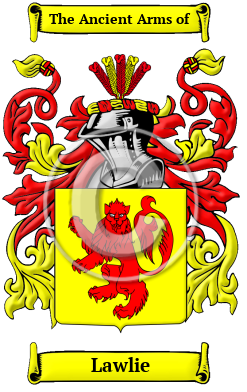
| ![Show Contents]() Lawlie History, Family Crest & Coats of Arms Lawlie History, Family Crest & Coats of Arms
- Origins Available:
Ireland
Etymology of LawlieWhat does the name Lawlie mean? The family name Lawlie has an intrinsic connection to the Gaelic culture of Ireland. The original Gaelic form of the name Lawlie is Ó Leathlobhair, which is derived from the words leath, which means half, and lobhar, which means sick person or leper. Early Origins of the Lawlie familyThe surname Lawlie was first found in County Leix (Irish: Laois) formerly known as Queen's County, located in central Ireland, in Leinster Province, where they held a family seat from ancient times. Early History of the Lawlie familyThis web page shows only a small excerpt of our Lawlie research. Another 63 words (4 lines of text) covering the year 1854 is included under the topic Early Lawlie History in all our PDF Extended History products and printed products wherever possible. Lawlie Spelling VariationsThe scribes and church officials of the Middle Ages who recorded names in official documents spelled the names as they sounded. This led to the problem of one name being recorded under several different variations and thus resembling more than one person. Among the many spelling variations of the surname Lawlie that are preserved in archival documents of this era include Lawlor, Lalor, O'Lalor, O'Lawlor and others. Early Notables of the Lawlie familyPatrick Lalor, M.P. for Leix, and his sons, James Fintan, writer and revolutionary, Peter, who led the miners revolt at Eureka, Australia in 1854 and later became speaker of the Legislative Council of Victoria, Thomas a general...
Another 37 words (3 lines of text) are included under the topic Early Lawlie Notables in all our PDF Extended History products and printed products wherever possible. Migration of the Lawlie familyIrish emigration to North America began modestly in the late 18th century. At this time, Irish families made the journey to British North America and the United States by choice and after careful consideration: they were primarily in search of a suitably large stretch of land to call their own. This pattern would change most dramatically during the Great Potato Famine of the late 1840s. For example, the years 1825-1845 saw approximately 450,000 heading to British North America and 400,000 to the United States, but in 1847, at the height of the famine, it is estimated that more than 104,000 Irish immigrants went to British North America and more than 119,000 to the United States. An examination of passenger and immigration lists has revealed many early immigrants bearing the name Lawlie: Margaret Lawler settled in Maryland in 1741; Darby Lawler settled in Boston in 1766 along with Betsy; Luke, David, Hugh, James, John, Michael, Patrick and William Lawler, all arrived in Philadelphia between 1840 and 1860.
 |