| ![Show Contents]() Laudor History, Family Crest & Coats of Arms Laudor History, Family Crest & Coats of Arms
Etymology of LaudorWhat does the name Laudor mean? In the ancient Scottish-English border region, the ancestors of the name Laudor lived among the Boernicians. They lived in Berwickshire, where they took their name from the lands of Lauder, first granted to them by King Malcolm Ceanmore about 1057 AD. "This place, of which the name, in the Celtic language, is descriptive of its situation in the valley of the Leader [River], was granted in the early part of the 12th century, by David I." 1 Another source claims the name was from Lauder (Lowther) meaning famous warrior. 2 Early Origins of the Laudor familyThe surname Laudor was first found in Berwickshire an ancient county of Scotland, presently part of the Scottish Borders Council Area, located in the eastern part of the Borders Region of Scotland, where Robert Lauder was the first Chief of the Clan. His successor Sir Robert de Lauedre, witnessed a charter by John de Mautelent to the Abbey of Dryburgh at an undetermined date some time in the early to mid 13th century. "Bass Isle in the parish of North Berwick, county of Haddington was an ancient possession of the family of Lawder, and was purchased, in 1671, by Charles II." 1 Early record show: "Robert de Lavedre is said to have obtained lands in Berwickshire from Malcolm Canmore. Sir Robert de Lauedre witnessed a charter by John de Mautelent to the Abbey of Dryburgh (Dryburgh), and William de Lawedre appears as sheriff of Perthshire in reign of Alexander III. As early as 1297 the Lauders were possessors of the Bass Rock in the Firth of Forth. Robert de Lauueder, who had a charter of the lands of Colden in barony of Dalkeith, 1316, may be Robert de Loweder, justiciar of Lothian, 1327-1331. Another Robert de Lawdre was one of the borowis for the earl of Douglas's bounds on the Middle March, 1398." 3 Early History of the Laudor familyThis web page shows only a small excerpt of our Laudor research. Another 174 words (12 lines of text) covering the years 1239, 1315, 1333, 1388, 1413, 1420, 1425, 1426, 1445, 1451, 1465, 1477, 1478, 1480, 1498, 1550, 1595, 1646, 1669, 1692, 1698, 1699, 1701, 1702, 1714, 1722, 1728, 1730 and 1771 are included under the topic Early Laudor History in all our PDF Extended History products and printed products wherever possible. Laudor Spelling VariationsSpelling rules only evolved in the last few centuries with the invention of the printing press and the first dictionaries. Spelling variations are extremely common in names from before that period. Laudor has been spelled Lauder, Laudor, Lawder, Lawther, Leather, Lauther and others. Early Notables of the Laudor familySir John Lauder, 1st Baronet, of Newington and Fountainhall (1595-1692), Scottish baillie and Treasurer of the City of Edinburgh; Sir John Lauder of Fountainhall, 2nd Baronet, Lord Fountainhall (1646-1722), one of Scotland's leading jurists; Sir John Lauder of Fountainhall, 3rd Baronet (1669-1728), Scottish burgess of Aberdeen (1701), city of...
Another 48 words (3 lines of text) are included under the topic Early Laudor Notables in all our PDF Extended History products and printed products wherever possible. Migration of the Laudor family to IrelandSome of the Laudor family moved to Ireland, but this topic is not covered in this excerpt. More information about their life in Ireland is included in all our PDF Extended History products and printed products wherever possible. Migration of the Laudor familyAfter making their great crossing, many Boernician-Scottish families settled along the east coast of North America. When the War of Independence broke out, United Empire Loyalists moved north to Canada while the rest stayed to fight. The ancestors of many of these Scots still populate the continent. This century, through Clan societies and other Scottish organizations, they began to rediscover their collective national heritage. Analysis of immigration records indicates that some of the first North American immigrants bore the name Laudor or a variant listed above: George Lauder settled in Virginia in 1716; John and Sarah Lauder settled in Belfast Maine in 1820.
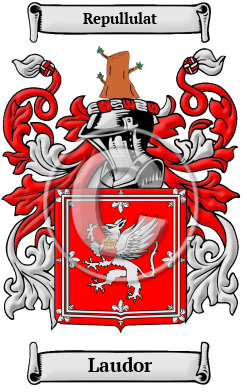
The motto was originally a war cry or slogan. Mottoes first began to be shown with arms in the 14th and 15th centuries, but were not in general use until the 17th century. Thus the oldest coats of arms generally do not include a motto. Mottoes seldom form part of the grant of arms: Under most heraldic authorities, a motto is an optional component of the coat of arms, and can be added to or changed at will; many families have chosen not to display a motto.
Motto: Repullulat
Motto Translation: It buds afresh.
- Lewis, Samuel, A Topographical Dictionary of Scotland. Institute of Historical Research, 1848, Print.
- Smith, Eldson Coles, New Dictionary of American Family Names New York: Harper & Row, 1956. Print
- Black, George F., The Surnames of Scotland Their Origin, Meaning and History. New York: New York Public Library, 1946. Print. (ISBN 0-87104-172-3)
 |