| ![Show Contents]() Langum History, Family Crest & Coats of Arms Langum History, Family Crest & Coats of Arms
- Origins Available:
England
Etymology of LangumWhat does the name Langum mean? There have long been several places named Langham in Britain: there is a village so named in Rutland that dates back to before the Domesday Book 1, as does the village of Langham in North Essex, which was a Saxon settlement. There was also a Langham in Norfolk and Suffolk. It is most likely that the surname Langum was originally born by someone who hailed from one of these villages. Early Origins and Etymology of LangumThe surname Langum was first found in Suffolk where the family name was first referenced in the Hundredorum Rolls of 1273 as William de Langham. The same rolls lists Henry de Longeham in Lincolnshire; and Dionis de Langham in Norfolk. 2 The Subsidy Rolls of 1327 lists William of Langham in Leicestershire. The name is thought to have meant "homestead of the family" or "followers of a man called Lahha." 3 Some of the family were found at Elkington in Northamptonshire since the early days. "This parish, through which passes the Grand Union canal, comprises 1868 acres of a moderately productive soil, the property of the Earl Spencer and the Langham family. " 4 Cardinal Simon Langham (1310-1376) was an English clergyman and Archbishop of Canterbury (1366-1368) Early History of the Langum familyThis web page shows only a small excerpt of our Langum research. Another 184 words (13 lines of text) covering the years 1310, 1363, 1366, 1376, 1395, 1455, 1487, 1510, 1538, 1584, 1600, 1621, 1625, 1654, 1656, 1660, 1670, 1671, 1678, 1696, 1698, 1699, 1700, 1747, 1749 and 1766 are included under the topic Early Langum History in all our PDF Extended History products and printed products wherever possible. Langum Spelling VariationsIt is only in the last few hundred years that the English language has been standardized. For that reason, early Anglo-Saxon surnames like Langum are characterized by many spelling variations. As the English language changed and incorporated elements of other European languages, even literate people changed the spelling of their names. Scribes and monks in the Middle Ages spelled names they sounded, so it is common to find several variations that refer to a single person. The variations of the name Langum include: Langham, Langam, Langum, Langhan, Langhen, Langholm and many more. Early Notables of the Langum familyCardinal Simon de Langham (c.1310-1376), Lord Chancellor of England in 1363 and Archbishop of Canterbury in 1366, he fell foul of Edward III later, and lived out the rest of his life in Avignon, France; Sir John Langham, 1st Baronet (1584-1671), an English politician who sat in the House of Commons in 1654 and 1660, a turkey merchant by trade, he acquired a considerable fortune in London; and his son...
Another 70 words (5 lines of text) are included under the topic Early Langum Notables in all our PDF Extended History products and printed products wherever possible. Migration of the Langum familyMany English families tired of political and religious strife left Britain for the new colonies in North America. Although the trip itself offered no relief - conditions on the ships were extremely cramped, and many travelers arrived diseased, starving, and destitute - these immigrants believed the opportunities that awaited them were worth the risks. Once in the colonies, many of the families did indeed prosper and, in turn, made significant contributions to the culture and economies of the growing colonies. An inquiry into the early roots of North American families has revealed a number of immigrants bearing the name Langum or a variant listed above: Christopher Langham, who arrived in New York in 1633; Phillip Langham, who came to Virginia in 1658; and Francis Langham, who came to Barbados in 1664..
| Contemporary Notables of the name Langum (post 1700) | + |
- S. A. Langum, American Republican politician, Alternate Delegate to Republican National Convention from Minnesota, 1904 5
- I. G. Langum, American politician, Mayor of St. Charles, Illinois, 1935-42 6
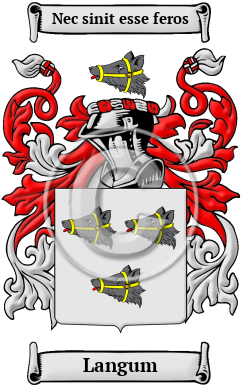
The motto was originally a war cry or slogan. Mottoes first began to be shown with arms in the 14th and 15th centuries, but were not in general use until the 17th century. Thus the oldest coats of arms generally do not include a motto. Mottoes seldom form part of the grant of arms: Under most heraldic authorities, a motto is an optional component of the coat of arms, and can be added to or changed at will; many families have chosen not to display a motto.
Motto: Nec sinit esse feros
Motto Translation: Education does not suffer them to be brutal.
- Williams, Dr Ann. And G.H. Martin, Eds., Domesday Book A Complete Translation. London: Penguin, 1992. Print. (ISBN 0-141-00523-8)
- Bardsley, C.W, A Dictionary of English and Welsh Surnames: With Special American Instances. Wiltshire: Heraldry Today, 1901. Print. (ISBN 0-900455-44-6)
- Mills, A.D., Dictionary of English Place-Names. Oxford: Oxford University Press, 1991. Print. (ISBN 0-19-869156-4)
- Lewis, Samuel, A Topographical Dictionary of England. Institute of Historical Research, 1848, Print.
- The Political Graveyard: Alphabetical Name Index. (Retrieved 2015, December 1) . Retrieved from http://politicalgraveyard.com/alpha/index.html
 |