| ![Show Contents]() Kinnin History, Family Crest & Coats of Arms Kinnin History, Family Crest & Coats of Arms
- Origins Available:
Scotland
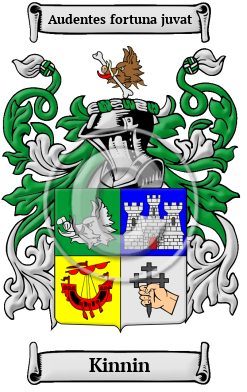
Etymology of KinninWhat does the name Kinnin mean? Kinnin is one of the names derived from the families of the ancient Dalriadan clans of Scotland. It is derived from the Gaelic personal name Findgaine. This is derived from the earlier forms Finghin and Finnguine. The Gaelic form of the surname is Mac Fhionghuin or Mac Fhionnghain. Kinnin Coat of Arms CreationThe Mackinnons have a boar's head with a shin bone in its mouth, which was adopted as their crest in memory of the following legendary incident. Mackinnon of Strathaird in Skye and six men were out after deer, and when the hunt was over they went into a cave where they roasted some venison. While they were eating it, the mouth of the cave was darkened by a huge boar, evidently ready to attack them. His men retreated to the innermost recesses of the cave, but Mackinnon remained ready to face the boar. Just as it was in the act of charging, he thrust the shin bone down the animal's throat and choked it. Hence the crest. The motto is in Latin " Audentes fortuna juvat " (Fortune favours the daring). 1 Early Origins of the Kinnin familyThe surname Kinnin was first found in on the Isles of Mull and Skye, where they held a family seat from early times. This distinguished Scottish Clan descended from Kenneth MacAlpin, King of Scotland who died in the 9th century and were part of the Siol Alpin, a group of Clans descended from the King. They held lands in Mull, Skye and Iona, and were long time Abbots of Iona. They were connected with the MacDonalds and other Alpin Clans such as the MacNabs and the MacGregors. The Clan was present at the Battle of Inverlochy under the Montrose and being of royalist influence they supported King Charles at Worcester. Again in 1745 in Culloden they supported the Stuarts and the Chief was imprisoned in London in the Tower. Early History of the Kinnin familyThis web page shows only a small excerpt of our Kinnin research. Another 319 words (23 lines of text) covering the years 1409, 1467, 1495, 1506, 1536, 1545, 1557, 1560, 1577, 1586, 1609, 1621, 1662, 1673, 1675, 1681, 1745, 1789, 1791, 1804, 1808, 1812, 1813, 1814, 1826, 1829, 1830, 1836, 1870 and 1884 are included under the topic Early Kinnin History in all our PDF Extended History products and printed products wherever possible. Kinnin Spelling VariationsSpelling in the medieval era was a highly imprecise process. Translation, particularly from Gaelic to English, was little better. For these reasons, early Scottish names are rife with spelling variations. In various documents Kinnin has been spelled MacKinnon, MacKinning, MacInnon, MacKinnen, MacFingon and many more. Early Notables of the Kinnin familyDaniel MacKinnon (1791-1836), colonel and historian of the Coldstream guards, born in 1791, was son of William Mackinnon, chief of the Clan Mackinnon. William Alexander Mackinnon (1789-1870) was his elder brother, and Daniel Henry Mackinnon (1813-1884) was his first cousin.
On 16 June 1804 he was appointed ensign in the Coldstream guards, in which his uncle, Henry Mackinnon, author of 'A Journal of...
Another 62 words (4 lines of text) are included under the topic Early Kinnin Notables in all our PDF Extended History products and printed products wherever possible.
| Kinnin migration to the United States | + |
The hardy Scots who made the crossing settled all along the east coast of North America and in the great west that was just then opening up. At the time of the American War of Independence, many United Empire Loyalists moved north from the American colonies to Canada. Scottish national heritage became better known in North America in the 20th century through highland games and other patriotic events. An examination of immigration records and passenger ship lists revealed that people bearing the name Kinnin arrived in North America very early:
Kinnin Settlers in United States in the 18th Century- Michael Kinnin, aged 23, who landed in Maryland in 1775 2
The motto was originally a war cry or slogan. Mottoes first began to be shown with arms in the 14th and 15th centuries, but were not in general use until the 17th century. Thus the oldest coats of arms generally do not include a motto. Mottoes seldom form part of the grant of arms: Under most heraldic authorities, a motto is an optional component of the coat of arms, and can be added to or changed at will; many families have chosen not to display a motto.
Motto: Audentes fortuna juvat
Motto Translation: Fortune favours the bold
- Polson, Alexander, The Romance of Scottish Crests and Mottoes. Inverness: Walter Alexander, Inglis Street 1929. Print
- Filby, P. William, Meyer, Mary K., Passenger and immigration lists index : a guide to published arrival records of about 500,000 passengers who came to the United States and Canada in the seventeenth, eighteenth, and nineteenth centuries. 1982-1985 Cumulated Supplements in Four Volumes Detroit, Mich. : Gale Research Co., 1985, Print (ISBN 0-8103-1795-8)
 |