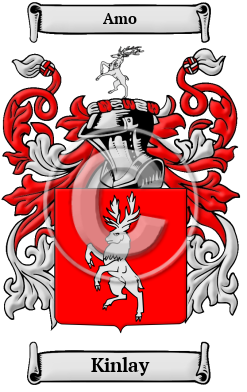
| ![Show Contents]() Kinlay History, Family Crest & Coats of Arms Kinlay History, Family Crest & Coats of Arms
Etymology of KinlayWhat does the name Kinlay mean? The sea-swept Hebrides islands and the west coast of Scotland are the ancestral home of the Kinlay family. Their name comes from the personal name Finlay. The Gaelic form of the surname is Mac Fionnlaigh, which means son of Finlay. Thus, Kinlay is a cognate of the surname Finlayson. Early Origins of the Kinlay familyThe surname Kinlay was first found in Perthshire (Gaelic: Siorrachd Pheairt) former county in the present day Council Area of Perth and Kinross, located in central Scotland, where the surname is still commonly found around Glenlyon and Balquhidder. The earliest known record of the name is from 1493, when Gillaspyk M'Kynlay witnessed legal proceedings involving Archibald, Earl of Argyll. Early History of the Kinlay familyThis web page shows only a small excerpt of our Kinlay research. Another 76 words (5 lines of text) covering the years 1511, 1675, 1700 and 1890 are included under the topic Early Kinlay History in all our PDF Extended History products and printed products wherever possible. Kinlay Spelling VariationsMedieval translation of Gaelic names could not be referred to as an accurate process. Spelling was not yet standardized, and names in documents from that era are riddled with spelling variations. Kinlay has been written as MacKinley, MacKinlay, MacKindlay, MacKinly, MacKindley and many more. Early Notables of the Kinlay familyAnother 32 words (2 lines of text) are included under the topic Early Kinlay Notables in all our PDF Extended History products and printed products wherever possible. Migration of the Kinlay family to IrelandSome of the Kinlay family moved to Ireland, but this topic is not covered in this excerpt.
Another 78 words (6 lines of text) about their life in Ireland is included in all our PDF Extended History products and printed products wherever possible.
| Kinlay migration to the United States | + |
Many of the ancestors of Dalriadan families who arrived in North America still live in communities along the east coast of Canada and the United States. In the American War of Independence many of the original settlers traveled north to Canada as United Empire Loyalists. In the late 19th and early 20th centuries the ancestors of many Scots began recovering their collective national heritage through Clan societies, highland games, and other patriotic events. Research into the origins of individual families in North America revealed records of the immigration of a number of people bearing the name Kinlay or a variant listed above:
Kinlay Settlers in United States in the 19th Century- John Kinlay, who landed in New York, NY in 1811 1
- George Kinlay, who arrived in New York, NY in 1811 1
- James Kinlay, who arrived in San Francisco, California in 1851 1
| Kinlay migration to New Zealand | + |
Emigration to New Zealand followed in the footsteps of the European explorers, such as Captain Cook (1769-70): first came sealers, whalers, missionaries, and traders. By 1838, the British New Zealand Company had begun buying land from the Maori tribes, and selling it to settlers, and, after the Treaty of Waitangi in 1840, many British families set out on the arduous six month journey from Britain to Aotearoa to start a new life. Early immigrants include: Kinlay Settlers in New Zealand in the 19th Century- Mr. John Kinlay, (b. 1863), aged Infant, Irish settler from County Down travelling from London aboard the ship "Tiptree" arriving in Lyttelton, Christchurch, South Island, New Zealand on 20th January 1864 2
- Mr. James Kinlay, (b. 1837), aged 26, Irish farm labourer from County Down travelling from London aboard the ship "Tiptree" arriving in Lyttelton, Christchurch, South Island, New Zealand on 20th January 1864 2
- Mr. George Kinlay, (b. 1839), aged 24, Irish farm labourer from County Down travelling from London aboard the ship "Tiptree" arriving in Lyttelton, Christchurch, South Island, New Zealand on 20th January 1864 2
- Mrs. Emily Kinlay, (b. 1840), aged 23, Irish settler from County Down travelling from London aboard the ship "Tiptree" arriving in Lyttelton, Christchurch, South Island, New Zealand on 20th January 1864 2
- Mrs. Margaret Kinlay, (b. 1843), aged 20, Irish settler from County Down travelling from London aboard the ship "Tiptree" arriving in Lyttelton, Christchurch, South Island, New Zealand on 20th January 1864 2
- ... (More are available in all our PDF Extended History products and printed products wherever possible.)
The motto was originally a war cry or slogan. Mottoes first began to be shown with arms in the 14th and 15th centuries, but were not in general use until the 17th century. Thus the oldest coats of arms generally do not include a motto. Mottoes seldom form part of the grant of arms: Under most heraldic authorities, a motto is an optional component of the coat of arms, and can be added to or changed at will; many families have chosen not to display a motto.
Motto: Amo
Motto Translation: I love.
- Filby, P. William, Meyer, Mary K., Passenger and immigration lists index : a guide to published arrival records of about 500,000 passengers who came to the United States and Canada in the seventeenth, eighteenth, and nineteenth centuries. 1982-1985 Cumulated Supplements in Four Volumes Detroit, Mich. : Gale Research Co., 1985, Print (ISBN 0-8103-1795-8)
- New Zealand Yesteryears Passenger Lists 1800 to 1900 (Retrieved 26th March 2019). Retrieved from http://www.yesteryears.co.nz/shipping/passlist.html
 |