
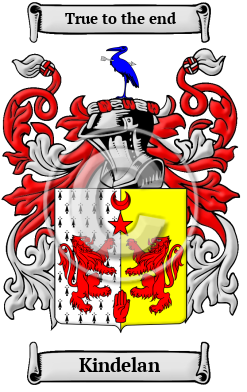
Show ContentsKindelan History, Family Crest & Coats of Arms

Etymology of Kindelan

What does the name Kindelan mean?

Irish surnames are all based on the Gaelic language native to Ireland. The original Gaelic form of the name Kindelan is Ó Caoinleain or Ó Caoindealbhain.

Early Origins of the Kindelan family

The surname Kindelan was first found in County Meath (Irish: An Mhí) anciently part of the kingdom of Brega, located in Eastern Ireland, in the province of Leinster, where they held a family seat from very ancient times.

Early History of the Kindelan family

This web page shows only a small excerpt of our Kindelan research. Another 91 words (6 lines of text) covering the year 1172 is included under the topic Early Kindelan History in all our PDF Extended History products and printed products wherever possible.

Kindelan Spelling Variations

The Middle Ages saw a great number of spelling variations for surnames common to the Irish landscape. One reason for these variations is the fact that surnames were not rigidly fixed by this period. The following variations for the name Kindelan were encountered in the archives: Quinlan, O'Quinlan, O'Quinlevan, O'Quinlivan and many more.

Early Notables of the Kindelan family

More information is included under the topic Early Kindelan Notables in all our PDF Extended History products and printed products wherever possible.


Kindelan migration to Australia +

Kindelan Settlers in Australia in the 19th Century
  • Edward Kindelan, aged 23, a servant, who arrived in South Australia in 1849 aboard the ship "Duke of Wellington" 1
  • Ann Kindelan, aged 25, a servant, who arrived in South Australia in 1849 aboard the ship "Duke of Wellington" 1
  • Mary Kindelan, aged 20, a servant, who arrived in South Australia in 1849 aboard the ship "Duke of Wellington" 1

Contemporary Notables of the name Kindelan (post 1700) +

  • Jean de Kindelan, French Divisional General during the French Revolutionary and Napoleonic Wars from 1789 to 1815 2


The Kindelan Motto +

The motto was originally a war cry or slogan. Mottoes first began to be shown with arms in the 14th and 15th centuries, but were not in general use until the 17th century. Thus the oldest coats of arms generally do not include a motto. Mottoes seldom form part of the grant of arms: Under most heraldic authorities, a motto is an optional component of the coat of arms, and can be added to or changed at will; many families have chosen not to display a motto.

Motto: True to the end


  1. State Records of South Australia. (Retrieved 2010, November 5) The DUKE OF WELLINGTON 1849. Retrieved from http://www.slsa.sa.gov.au/BSA/1849Duke%20of%20Wellington.htm
  2. Generals Who Served in the French Army during the Period 1789-1815. (Retrieved 2015, March 25) Jean Kindelan. Retrieved from http://www.napoleon-series.org/research/c_frenchgenerals.html


Houseofnames.com on Facebook