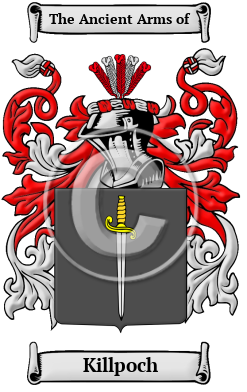
| ![Show Contents]() Killpoch History, Family Crest & Coats of Arms Killpoch History, Family Crest & Coats of Arms
- Origins Available:
England
Etymology of KillpochWhat does the name Killpoch mean? The ancestors of the bearers of the Killpoch family name are thought have lived in ancient Anglo-Saxon England. They were first found in Killpeck, (Kilpeck) a parish, in the union of Dore, Upper division of the hundred of Wormelow, county of Hereford (Herefordshire.) 1 2 3 This ancient place dates back to the Domesday Book of 1086 where it was registered as Chipeete. 4 According to the Domesday Survey, Kilpeck had "3 ploughs, 2 serfs and 4 oxmen and there are 57 men with 19 ploughs." The place name is derived from the Welsh word "cil", meaning "corner, nook." 5 This is the first evidence pointing to the possible Welsh origin of the name. In Welsh, the parish is named Llanddewi Cil Pedeg as in the 9th century, the area around Kilpeck was within the Welsh kingdom of Ergyng. An Archaeological Journal on the Remains of Shobdon Old Church, Herefordshire notes that the south door of the church of Kilpeck includes "figures of men supposed to represent Welsh knights, arranged in couples and interwoven with tracery" and "other monuments on the borders of Wales" include similar figures. "The two figures at Kilpeck are armed respectively with a sword and a kind of mace." The church is thought to have been built c. 1135. Early Origins of the Killpoch familyThe surname Killpoch was first found in Shropshire (Salop), where one of the first records found was that of Hagh de Kilpec, Salop, Henry III-Edward I. 6 Early History of the Killpoch familyThis web page shows only a small excerpt of our Killpoch research. Another 225 words (16 lines of text) covering the years 1086, 1300, 1500 and 1583 are included under the topic Early Killpoch History in all our PDF Extended History products and printed products wherever possible. Killpoch Spelling VariationsUntil quite recently, the English language has lacked a definite system of spelling rules. Consequently, Anglo-Saxon surnames are characterized by a multitude of spelling variations. Changes in Anglo-Saxon names were influenced by the evolution of the English language, as it incorporated elements of French, Latin, and other languages. Although Medieval scribes and church officials recorded names as they sounded, so it is common to find one person referred to by several different spellings of his surname, even the most literate people varied the spelling of their own names. Variations of the name Killpoch include Kilpack, Killpack, Kilpac, Kilpak, Killpak, Kilpeck, Killpeck, Kilpec, Killpec, Killpoch, Kilbeck, Killbeck, Kilbec and many more. Early Notables of the Killpoch familyMore information is included under the topic Early Killpoch Notables in all our PDF Extended History products and printed products wherever possible.
| Killpoch migration to the United States | + |
Searching for a better life, many English families migrated to British colonies. Unfortunately, the majority of them traveled under extremely harsh conditions: overcrowding on the ships caused the majority of the immigrants to arrive diseased, famished, and destitute from the long journey across the ocean. For those families that arrived safely, modest prosperity was attainable, and many went on to make invaluable contributions to the development of the cultures of the new colonies. Research into the origins of individual families in North America revealed records of the immigration of a number of people bearing the name Killpoch or a variant listed above:
Killpoch Settlers in United States in the 17th Century- Thomas Killpoch, who sailed to Virginia between 1663 and 1679
- Lewis, Samuel, A Topographical Dictionary of England. Institute of Historical Research, 1848, Print.
- Barber, Henry, British Family Names London: Elliot Stock, 62 Paternoster Row, 1894. Print.
- Lower, Mark Anthony, Patronymica Britannica, A Dictionary of Family Names of the United Kingdom. London: John Russel Smith, 1860. Print.
- Williams, Dr Ann. And G.H. Martin, Eds., Domesday Book A Complete Translation. London: Penguin, 1992. Print. (ISBN 0-141-00523-8)
- Mills, A.D., Dictionary of English Place-Names. Oxford: Oxford University Press, 1991. Print. (ISBN 0-19-869156-4)
- Testa de Nevill or "Liber Feodorum" or "Book of Fees," thought to have been written by Ralph de Nevill, for King John (1199–1216)
 |