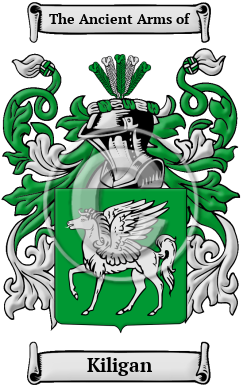
Many Irish names are merely English translations of Gaelic names. The name Kiligan was a translation of the Gaelic name Mac Giollagain, which is derived from the word "giolla," which means "lad."
Loading...
Early Origins of the Kiligan family
The surname Kiligan was first found in County Londonderry (Irish: Doire), a Northern Irish county also known as Derry, in the province of Ulster, where they held a family seat at a place called Magilligans Strand.
Early History of the Kiligan family
This web page shows only a small excerpt of our Kiligan research. Another 50 words (4 lines of text) are included under the topic Early Kiligan History in all our PDF Extended History products and printed products wherever possible.
Kiligan Spelling Variations
In the days before Gaelic or English gained any significant semblance of standardization, the scribes who created documents simply recorded names as they sounded. Consequently, in the Middle Ages many people were recorded under different spellings each time their name was written down. Research into the Kiligan family history revealed numerous spelling variations of the name, including Gilligan, Gilegan, Gillegan, Giligan and others.
Early Notables of the Kiligan family
More information is included under the topic Early Kiligan Notables in all our PDF Extended History products and printed products wherever possible.
Loading...
Loading...
Loading...
Loading...
Migration of the Kiligan family
Ireland, as an English-controlled colony in the 19th century, suffered the loss of hundreds of thousands of its native people. The system of land ownership often did not sufficiently provide for the tenants who farmed the land. This was most clearly evidenced in the Great Potato Famine of the 1840s. Previous years of great demand for grain products and livestock had run the land down. Many landowners foreseeing an upcoming crisis often removed families from the land or forced them to rely on pitifully small plots where only a subsistence living could be made. When the famines of 1845, 46, and 48 hit, many had nothing. Disease and starvation became widespread and families boarded ships for elsewhere any way they could. Those who went to America were instrumental in developing the industrial power known today: many Irish were employed in hard labor positions in factories and in building the bridges, canals, roads, and railways necessary for a strong industrial nation. Research of early immigration and passenger lists has shown that many bearers of the name Kiligan: Charles, James, John, Michael, Patrick and Thomas Gilligan, all arrived in Philadelphia between 1840 and 1870.