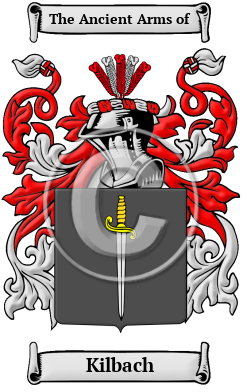
| ![Show Contents]() Kilbach History, Family Crest & Coats of Arms Kilbach History, Family Crest & Coats of Arms
- Origins Available:
England
Etymology of KilbachWhat does the name Kilbach mean? The ancient roots of the Kilbach family name are in the Anglo-Saxon culture. The name Kilbach comes from when the family lived in Killpeck, (Kilpeck) a parish, in the union of Dore, Upper division of the hundred of Wormelow, county of Hereford (Herefordshire.) 1 2 3 This ancient place dates back to the Domesday Book of 1086 where it was registered as Chipeete. 4 According to the Domesday Survey, Kilpeck had "3 ploughs, 2 serfs and 4 oxmen and there are 57 men with 19 ploughs." The place name is derived from the Welsh word "cil", meaning "corner, nook." 5 This is the first evidence pointing to the possible Welsh origin of the name. In Welsh, the parish is named Llanddewi Cil Pedeg as in the 9th century, the area around Kilpeck was within the Welsh kingdom of Ergyng. An Archaeological Journal on the Remains of Shobdon Old Church, Herefordshire notes that the south door of the church of Kilpeck includes "figures of men supposed to represent Welsh knights, arranged in couples and interwoven with tracery" and "other monuments on the borders of Wales" include similar figures. "The two figures at Kilpeck are armed respectively with a sword and a kind of mace." The church is thought to have been built c. 1135. Early Origins of the Kilbach familyThe surname Kilbach was first found in Shropshire (Salop), where one of the first records found was that of Hagh de Kilpec, Salop, Henry III-Edward I. 6 Early History of the Kilbach familyThis web page shows only a small excerpt of our Kilbach research. Another 225 words (16 lines of text) covering the years 1086, 1300, 1500 and 1583 are included under the topic Early Kilbach History in all our PDF Extended History products and printed products wherever possible. Kilbach Spelling VariationsOne relatively recent invention that did much to standardize English spelling was the printing press. However, before its invention even the most literate people recorded their names according to sound rather than spelling. The spelling variations under which the name Kilbach has appeared include Kilpack, Killpack, Kilpac, Kilpak, Killpak, Kilpeck, Killpeck, Kilpec, Killpec, Killpoch, Kilbeck, Killbeck, Kilbec and many more. Early Notables of the Kilbach familyMore information is included under the topic Early Kilbach Notables in all our PDF Extended History products and printed products wherever possible. Migration of the Kilbach familyAt this time, the shores of the New World beckoned many English families that felt that the social climate in England was oppressive and lacked opportunity for change. Thousands left England at great expense in ships that were overcrowded and full of disease. A great portion of these settlers never survived the journey and even a greater number arrived sick, starving, and without a penny. The survivors, however, were often greeted with greater opportunity than they could have experienced back home. These English settlers made significant contributions to those colonies that would eventually become the United States and Canada. An examination of early immigration records and passenger ship lists revealed that people bearing the name Kilbach arrived in North America very early: Thomas Killpoch, who sailed to Virginia between 1663 and 1679.
- Lewis, Samuel, A Topographical Dictionary of England. Institute of Historical Research, 1848, Print.
- Barber, Henry, British Family Names London: Elliot Stock, 62 Paternoster Row, 1894. Print.
- Lower, Mark Anthony, Patronymica Britannica, A Dictionary of Family Names of the United Kingdom. London: John Russel Smith, 1860. Print.
- Williams, Dr Ann. And G.H. Martin, Eds., Domesday Book A Complete Translation. London: Penguin, 1992. Print. (ISBN 0-141-00523-8)
- Mills, A.D., Dictionary of English Place-Names. Oxford: Oxford University Press, 1991. Print. (ISBN 0-19-869156-4)
- Testa de Nevill or "Liber Feodorum" or "Book of Fees," thought to have been written by Ralph de Nevill, for King John (1199–1216)
 |