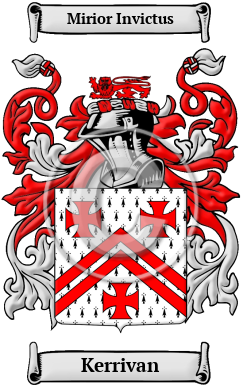
Show ContentsKerrivan History, Family Crest & Coats of Arms

Etymology of Kerrivan

What does the name Kerrivan mean?

Today's Irish surnames are underpinned by a multitude of rich histories. The name Kerrivan originally appeared in Gaelic as Ó Gairbhin, derived from the word "garbh," which means "rough." 1

Early Origins of the Kerrivan family

The surname Kerrivan was first found in County Tyrone (Irish: Tír Eoghain), the ancient territory of the O'Neills, now in the Province of Ulster, central Northern Ireland, where they held a family seat from very ancient times.

Early History of the Kerrivan family

This web page shows only a small excerpt of our Kerrivan research. Another 135 words (10 lines of text) covering the years 1000, 1527, 1558, 1560 and 1595 are included under the topic Early Kerrivan History in all our PDF Extended History products and printed products wherever possible.

Kerrivan Spelling Variations

Spelling variations of this family name include: Garvin, Garvey, Garwin, Garvine, Garven, Garvan, Garvy, Garvie, Garwen and many more.

Early Notables of the Kerrivan family

John Garvey (1527-1595), an Irish Protestant bishop of Kilmore and Archbishop of Armagh. He was the eldest son of John O'Garvey of Morisk, co. Mayo and was born in the county of Kilkenny. "He was educated at Oxford, where he graduated in the reign of Edward VI; but through some negligence his name does not appear in the public register of the time (Wood, Athenæ Oxonienses, ed. Bliss...
Another 68 words (5 lines of text) are included under the topic Early Kerrivan Notables in all our PDF Extended History products and printed products wherever possible.

Migration of the Kerrivan family

Some of the first settlers of this family name or some of its variants were: James Garvey who settled in Virginia in 1680; Daniel Garvin, an 'enforced' Irish emigrant, sent to America in 1742; Patrick Garve, who settled in Pennsylvania in 1773.


The Kerrivan Motto +

The motto was originally a war cry or slogan. Mottoes first began to be shown with arms in the 14th and 15th centuries, but were not in general use until the 17th century. Thus the oldest coats of arms generally do not include a motto. Mottoes seldom form part of the grant of arms: Under most heraldic authorities, a motto is an optional component of the coat of arms, and can be added to or changed at will; many families have chosen not to display a motto.

Motto: Mirior Invictus
Motto Translation: Death before Defeat


  1. MacLysaght, Edward, The Surnames of Ireland. Ireland: Irish Academic Press, sixth edition, 1985. Print. (ISBN 0-7165-2366-3)


Houseofnames.com on Facebook