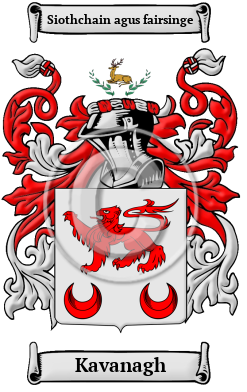
| ![Show Contents]() Kavanagh History, Family Crest & Coats of Arms Kavanagh History, Family Crest & Coats of Arms
- Origins Available:
Ireland-Alt
Ireland
Etymology of KavanaghWhat does the name Kavanagh mean? Irish names tend to vary widely in their spelling and overall form. The original Gaelic form of the name Kavanagh is Caomhanach, an adjective denoting association with St. Caomhan. The first Kavanagh, Donal, the son of Dermot MacMurrough, was fostered by a successor of this saint. Early Origins of the Kavanagh familyThe surname Kavanagh was first found in County Carlow (Irish: Cheatharlach) a small landlocked area located in the province of Leinster in the South East of Ireland, where they held a family seat from very ancient times. Early History of the Kavanagh familyThis web page shows only a small excerpt of our Kavanagh research. Another 141 words (10 lines of text) covering the year 1889 is included under the topic Early Kavanagh History in all our PDF Extended History products and printed products wherever possible. Kavanagh Spelling VariationsSpelling variations of this family name include: Cavanagh, Kavanagh, Kavanah, Cavanaugh, Keevan, Cavanaw, Kavanaw, Cavenaugh, Cavanough, Cavaneagh, Cavana, Cavena, Cavinaugh, Kavina, Kavena, Kavanaugh, Cavanach, Kavanach, Cabenagh, O'Cavanagh, O'Kavanagh, Keaveney, Geaveney, M'Cavanna and many more. Early Notables of the Kavanagh familyMore information is included under the topic Early Kavanagh Notables in all our PDF Extended History products and printed products wherever possible. Kavanagh World RankingIn the United States, the name Kavanagh is the 7,087th most popular surname with an estimated 4,974 people with that name. 1 However, in Newfoundland, Canada, the name Kavanagh is ranked the 164th most popular surname with an estimated 239 people with that name. 2 And in Australia, the name Kavanagh is the 878th popular surname with an estimated 4,502 people with that name. 3 The United Kingdom ranks Kavanagh as 907th with 7,567 people. 4
| Kavanagh migration to the United States | + |
Kavanagh Settlers in United States in the 19th Century- J. Kavanagh, who settled in Baltimore Maryland in 1822
- James, John, Lawrence, Michael, Patrick, Peter, Thomas Kavanagh, all, who arrived in Philadelphia, Pennsylvania between 1811 and 1843
- James Kavanagh who arrived in New York State in 1852
| Kavanagh migration to Canada | + |
Kavanagh Settlers in Canada in the 19th Century- Patrick Kavanagh, who arrived in Halifax, Nova Scotia in 1806
| Kavanagh migration to Australia | + |
Kavanagh Settlers in Australia in the 18th Century- Mr. Patrick Kavanagh, Irish soldier who was convicted in Ireland for life for desertion, transported aboard the "Friendship" on 24th August 1799, arriving in New South Wales, Australia 5
Kavanagh Settlers in Australia in the 19th Century- Mr. Michael Kavanagh, Irish convict who was convicted in Kerry, Ireland for 7 years, transported aboard the "Atlas" on 29th November 1801, arriving in New South Wales, Australia 6
- Mr. Patrick Kavanagh, Irish convict who was convicted in Dundalk, Ireland for life, transported aboard the "Atlas" on 29th November 1801, arriving in New South Wales, Australia 6
- Miss Mary Kavanagh, (b. 1783), aged 30, Irish convict who was convicted in Dublin, Ireland for 7 years, transported aboard the "Catherine" on 8th December 1813, arriving in New South Wales, Australia 7
- Mr.James Kavanagh, (Cavanagh), (b. 1790), aged 29, Irish farm labourer who was convicted in Dublin, Ireland for 7 years for stealing, transported aboard the "Bencoolen" on 24th April 1819, arriving in New South Wales, Australia before being transferred to Tasmania via the "Admiral Cockburn" 8
- Mr. Lawrence Kavanagh, (b. 1812), aged 16, Irish stone mason who was convicted in Dublin, Ireland for life for burglary, transported aboard the "Fergusson" on 16th November 1828, arriving in New South Wales, Australia, he was executed in 1846 9
- ... (More are available in all our PDF Extended History products and printed products wherever possible.)
| Kavanagh migration to New Zealand | + |
Emigration to New Zealand followed in the footsteps of the European explorers, such as Captain Cook (1769-70): first came sealers, whalers, missionaries, and traders. By 1838, the British New Zealand Company had begun buying land from the Maori tribes, and selling it to settlers, and, after the Treaty of Waitangi in 1840, many British families set out on the arduous six month journey from Britain to Aotearoa to start a new life. Early immigrants include: Kavanagh Settlers in New Zealand in the 19th Century- Mr. Joseph Kavanagh, British settler travelling from Liverpool aboard the ship 'Mermaid' arriving in Auckland, New Zealand on 19th October 1859 10
- Edward Kavanagh, aged 21, a farm labourer, who arrived in Wellington, New Zealand aboard the ship "British Queen" in 1883 11
- Miss Ellen Kavanagh, (b. 1864), aged 20, British settler travelling from Plymouth aboard the ship "Florida" arriving in Invercargill, Southland, South Island, New Zealand on 10th March 1884 10
| Contemporary Notables of the name Kavanagh (post 1700) | + |
- Edward Kavanagh (1795-1844), American statesman and congressman
- Thomas M. Kavanagh (1909-1975), American jurist from Michigan; justice of the Michigan Supreme Court 1958–75
- Marty Kavanagh (1891-1960), American professional baseball player
- Leo Kavanagh (1894-1950), American professional baseball player
- Herminie Templeton Kavanagh (1861-1933), Irish-American short-story writer
- Giles Kavanagh, American politician, U.S. Collector of Internal Revenue for Michigan, 1941-51 12
- Francis B. Kavanagh, American politician, U.S. Attorney for the Northern District of Ohio, 1941-42 13
- Edward A. Kavanagh, American Democratic Party politician, Candidate for Michigan State Senate 16th District, 1966 13
- Edward Kavanagh (1795-1844), American Democratic Party politician, Member of Maine State House of Representatives, 1826-28; Member of Maine State Senate, 1842; Governor of Maine, 1843-44 13
- ... (Another 31 notables are available in all our PDF Extended History products and printed products wherever possible.)
| Historic Events for the Kavanagh family | + |
Royal Charter- Mr. Michael Kavanagh, British passenger who died aboard the ship "Royal Charter" when she sunk in a storm off the coast of Anglesey, Wales in 1859
The motto was originally a war cry or slogan. Mottoes first began to be shown with arms in the 14th and 15th centuries, but were not in general use until the 17th century. Thus the oldest coats of arms generally do not include a motto. Mottoes seldom form part of the grant of arms: Under most heraldic authorities, a motto is an optional component of the coat of arms, and can be added to or changed at will; many families have chosen not to display a motto.
Motto: Siothchain agus fairsinge
Motto Translation: Peace and plenty.
- "What are the 5,000 Most Common Last Names in the U.S.?". NameCensus.com, https://namecensus.com/last-names/
- The order of Common Surnames in 1955 in Newfoundland retrieved on 20th October 2021 (retrieved from Family Names of the Island of Newfoundland by E.R. Seary corrected edition ISBN 0-7735-1782-0)
- "Most Common Last Names in Australia." Forebears, https://forebears.io/australia/surnames
- "UK surname ranking." UK Surname map, https://www.surnamemap.eu/unitedkingdom/surnames_ranking.php?p=10
- Convict Records Voyages to Australia (Retrieved 24th October 2022). https://convictrecords.com.au
- Convict Records Voyages to Australia (Retrieved 14th July 2020). Retrieved from https://convictrecords.com.au/ships/atlas
- Convict Records of Australia (Retreived 2nd January 2021, retreived from https://convictrecords.com.au/ships/catherine
- Convict Records Voyages to Australia (Retrieved 5th October 2020). Retrieved from https://convictrecords.com.au/ships/bencoolen
- Convict Records Voyages to Australia (Retrieved 4th October 2022). https://convictrecords.com.au/ships/fergusson
- New Zealand Yesteryears Passenger Lists 1800 to 1900 (Retrieved 17th October 2018). Retrieved from http://www.yesteryears.co.nz/shipping/passlist.html
- New Zealand Yesteryears Passenger Lists 1800 to 1900 (Retrieved 12th November 2011). Retrieved from http://www.yesteryears.co.nz/shipping/passlist.html
- The Political Graveyard: Alphabetical Name Index. (Retrieved 2015, October 6) . Retrieved from http://politicalgraveyard.com/alpha/index.html
 |