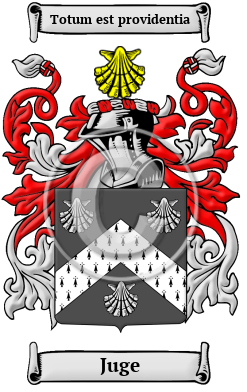
As an Irish surname, Juge was the translation of the Irish Gaelic Mac an Bhreitheamhnaigh. This same name was also anglicized and became MacEvrehoona, MacVrehonne, MacBrehon, and others.
Loading...
Early Origins of the Juge family
The surname Juge was first found in County Mayo (Irish: Maigh Eo) located on the West coast of the Republic of Ireland in the province of Connacht, where an Eugene MacBrehan was the Bishop of Mayo from 1541-1561. A Malachy MacBrehuna was the Archdeacon of Kilmacduagh. In counties Sligo and in north Roscommon, there were many registrations of the name which showed that many families were using the Judge and Breheny surnames indiscriminately.
Early History of the Juge family
This web page shows only a small excerpt of our Juge research. Another 99 words (7 lines of text) covering the years 1202, 1260 and 1296 are included under the topic Early Juge History in all our PDF Extended History products and printed products wherever possible.
Juge Spelling Variations
Spelling variations of this family name include: Judge, Juge, Jude and others.
Early Notables of the Juge family
More information is included under the topic Early Juge Notables in all our PDF Extended History products and printed products wherever possible.
Juge Ranking
In France, the name Juge is the 1,591st most popular surname with an estimated 3,739 people with that name. 1
Migration of the Juge family to Ireland
Some of the Juge family moved to Ireland, but this topic is not covered in this excerpt. Another 32 words (2 lines of text) about their life in Ireland is included in all our PDF Extended History products and printed products wherever possible.
Loading...
Loading...
Loading...
Loading...
Migration of the Juge family
Some of the first settlers of this family name or some of its variants were: Judith Judge, who settled in New England in 1748; Jane Judge, a convict sent to Virginia in 1754; Elizabeth Judge, who settled in New York in 1830; Bridget Judge, whose death at sea was registered at Grosse Isle, Quebec in 1847.
The motto was originally a war cry or slogan. Mottoes first began to be shown with arms in the 14th and 15th centuries, but were not in general use until the 17th century. Thus the oldest coats of arms generally do not include a motto. Mottoes seldom form part of the grant of arms: Under most heraldic authorities, a motto is an optional component of the coat of arms, and can be added to or changed at will; many families have chosen not to display a motto.
Motto: Totum est providentia Motto Translation: All is providence.