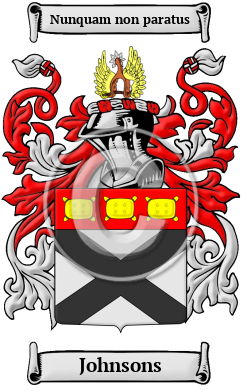
| ![Show Contents]() Johnsons History, Family Crest & Coats of Arms Johnsons History, Family Crest & Coats of Arms
Etymology of JohnsonsWhat does the name Johnsons mean? Johnsons is a name whose roots are found in the clans of the Boernician people of ancient Scotland. The Johnsons family lived in any of several place names in Scotland. Most instances of the name are thought to come from the barony of John's Town in Annandale, Dumfriesshire. The place name comes from the personal name John, and the Middle English tone or toun, meaning "a town." Other places so named in Scotland include St. John's Toun (now the city of Perth). Johnsons Coat of Arms CreationThe Johnstones have for ages been a famous Border family who had their home in Dumfriesshire. They once were wardens of the West Marches, and then had as their motto, " Light thieves all," which means "Alight from your horses and surrender," and which they shouted to Border marauders. As a crest they had a winged spur, and their motto then became " Nunquam non paratus" (Never unprepared), and both crest and motto were very appropriate for their duty. They were great enemies of the Maxwells, and much blood was shed in the fights between these two families. Another tradition as to the origin of this crest is that when Robert Bruce was in England one of the Johnstones heard that Edward I. wished to capture him, and therefore sent him a spur and a feather. Bruce at once knew what was meant and fled to Scotland, and the "winged spur" as a crest for the Johnstones was the result. 1 Early Origins of the Johnsons familyThe surname Johnsons was first found in Dumfries (now part of the region of Galloway) where they held the barony of John's Town. There is a heraldic similarity with the Kirkpatrick family coat of arms, leading to the belief that John was a descendant of Gospatrick, Earl of Northumberland. Gilbert, son of John received a parcel of land in southern Annandale from William Bruce, Lord of Annandale, some time between 1195 and 1214. "Shortly after 1174 John the founder of the family of Johnstone, gave his name to his lands in Annandale, Dumfriesshire, whence his son Gilbert took his surname. 'Who John, the father of Gilbert, was it is now perhaps impossible to determine. He may have been a native settler who, when the Bruces were made lords of Annandale, elected to hold his lands from them, or, as seems most likely, he followed his overlords from their Yorkshire, or more southern, estates, and was gifted with the lands to which he gave his name, and which, later, formed the parish and barony of Johnstone.'" 2 Early History of the Johnsons familyThis web page shows only a small excerpt of our Johnsons research. Another 240 words (17 lines of text) covering the years 1296, 1602, 1611, 1625, 1653, 1663, 1664, 1672, 1687, 1697, 1700, 1701, 1711, 1721, 1730, 1743, 1754, 1772 and 1890 are included under the topic Early Johnsons History in all our PDF Extended History products and printed products wherever possible. Johnsons Spelling VariationsScribes in the Middle Ages simply spelled according to sound. The result is an enormous number of spelling variations among names that evolved in that era. Johnsons has been spelled Jonsoom, Jonstoombe, Johnson, Johnstome, Jonstoom, Jonstoomb, Johnstolm, Jonsome, Johnstume, Jonstolm, Jonsolm, Jonstum, Jonstome, Jonsom, Jonsum, Jonstume, Jonsomb, Jonsombe, Jonsoombe, Jonsoomb and many more. Early Notables of the Johnsons familyArchibald Johnston, Lord Warriston (1611-1663), a Scottish judge and statesman; James Johnstone (1625-1672), 1st Earl of Annandale and Hartfell; his son William Johnstone (1664-1721), 2nd Earl of Annandale and Hartfell, who was made 1st Marquess of Annandale in 1701; James Johnstone, 1st Earl of Hartfell (1602-1653), Scottish peer and Royalist; James Johnstone...
Another 51 words (4 lines of text) are included under the topic Early Johnsons Notables in all our PDF Extended History products and printed products wherever possible. Migration of the Johnsons family to IrelandSome of the Johnsons family moved to Ireland, but this topic is not covered in this excerpt.
Another 73 words (5 lines of text) about their life in Ireland is included in all our PDF Extended History products and printed products wherever possible.
| Johnsons migration to the United States | + |
Most of the Boernician-Scottish families who came to North America settled on the eastern seaboard of what would become the United States and Canada. Families who wanted a new order stayed south in the War of Independence, while those who were still loyal to the crown went north to Canada as United Empire Loyalists. In the 20th century, the ancestors of these families have gone on to rediscover their heritage through Clan societies and other patriotic Scottish organizations. Research into the origins of individual families in North America has revealed records of the immigration of a number of people bearing the name Johnsons or a variant listed above:
Johnsons Settlers in United States in the 17th Century- Alice Johnsons, who landed in Virginia in 1638 3
- Mary Johnsons, who arrived in Virginia in 1638 3
| Johnsons migration to Australia | + |
Johnsons Settlers in Australia in the 19th Century- Miss Elizabeth Johnsons who was convicted in Gloucester, Gloucestershire, England for 10 years, transported aboard the "Emma Eugenia" on 16th November 1843, arriving in Tasmania (Van Diemen's Land) 4
The motto was originally a war cry or slogan. Mottoes first began to be shown with arms in the 14th and 15th centuries, but were not in general use until the 17th century. Thus the oldest coats of arms generally do not include a motto. Mottoes seldom form part of the grant of arms: Under most heraldic authorities, a motto is an optional component of the coat of arms, and can be added to or changed at will; many families have chosen not to display a motto.
Motto: Nunquam non paratus
Motto Translation: Never unprepared
- Polson, Alexander, The Romance of Scottish Crests and Mottoes. Inverness: Walter Alexander, Inglis Street 1929. Print
- Black, George F., The Surnames of Scotland Their Origin, Meaning and History. New York: New York Public Library, 1946. Print. (ISBN 0-87104-172-3)
- Filby, P. William, Meyer, Mary K., Passenger and immigration lists index : a guide to published arrival records of about 500,000 passengers who came to the United States and Canada in the seventeenth, eighteenth, and nineteenth centuries. 1982-1985 Cumulated Supplements in Four Volumes Detroit, Mich. : Gale Research Co., 1985, Print (ISBN 0-8103-1795-8)
- Convict Records Voyages to Australia (Retrieved 31st March 2022). Retrieved from https://convictrecords.com.au/ships/emma-eugenia
 |