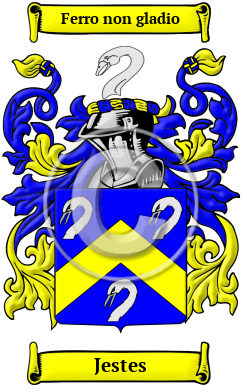
| ![Show Contents]() Jestes History, Family Crest & Coats of Arms Jestes History, Family Crest & Coats of Arms
Etymology of JestesWhat does the name Jestes mean? The surname Jestes was originally formed in the western region of Britain in the country of Wales. This name began as a nickname for a guest or stranger. The surname Jestes is derived from the Old English word "gest," which in turn comes from the Old Norse Word "gestr," which means "guest" or "stranger." Early Origins of the Jestes familyThe surname Jestes was first found in Worcestershire, where they held a family seat from very ancient times. Early History of the Jestes familyThis web page shows only a small excerpt of our Jestes research. Another 109 words (8 lines of text) covering the years 1248, 1273, 1604, 1722, 1762, 1763, 1785, 1835, 1846, 1852 and 1914 are included under the topic Early Jestes History in all our PDF Extended History products and printed products wherever possible. Jestes Spelling VariationsAlthough there are not an extremely large number Welsh surnames, there are an inordinately large number of spelling variations of those surnames. This variety of spellings began almost immediately after the acceptance of surnames within Welsh society. As time progressed, these old Brythonic names were eventually were recorded in English. This process was problematic in that many of the highly inflected sounds of the native language of Wales could not be properly captured in English. Some families, however, did decide to modify their own names to indicate a branch loyalty within the family, a religious adherence, or even a patriotic affiliation. The name Jestes has seen various spelling variations: Guest, Guests, Jeste and others. Early Notables of the Jestes familyJohn Guest (1722-1785), a brewer, farmer and coal merchant in Broseley, Shropshire, co-founder of the Plymouth Ironworks in 1763; Sir Josiah John Guest, 1st Baronet, (1785-1852), Welsh engineer and entrepreneur; Jane Mary Guest (c.1762-1846)...
Another 33 words (2 lines of text) are included under the topic Early Jestes Notables in all our PDF Extended History products and printed products wherever possible. Migration of the Jestes family to IrelandSome of the Jestes family moved to Ireland, but this topic is not covered in this excerpt.
Another 41 words (3 lines of text) about their life in Ireland is included in all our PDF Extended History products and printed products wherever possible. Migration of the Jestes familyThe Welsh migration to North America in the late 19th and early 20th centuries contributed greatly to its rapid development. These migrants were in search of land, work, and freedom. Those Welsh families that survived the long ocean journey were critical to the development of new industries and factories, and to the quick settlement of land. They also added to an ever-growing rich cultural heritage. A search of the immigration and passenger lists has shown a number of people bearing the name Jestes: George Guest purchased land in Virginia in 1647. Anthony Guest made the voyage in 1663. Henry Guest, his wife Mary, and their son, Henry, made their home in Philadelphia in 1686. By 1852.
The motto was originally a war cry or slogan. Mottoes first began to be shown with arms in the 14th and 15th centuries, but were not in general use until the 17th century. Thus the oldest coats of arms generally do not include a motto. Mottoes seldom form part of the grant of arms: Under most heraldic authorities, a motto is an optional component of the coat of arms, and can be added to or changed at will; many families have chosen not to display a motto.
Motto: Ferro non gladio
Motto Translation: By iron, not by the sword.
 |