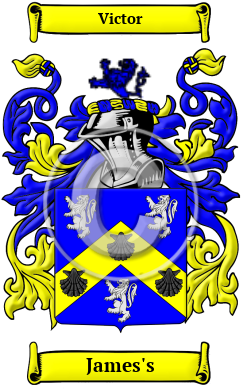
The ancestors of the James's family arrived in England following the Norman Conquest of 1066. The name James's came from the personal name Jacob, the Latin "Jacobus" via the Late Latin "Jacomus." The Latin "Jacobus" is derived from the Hebrew name Yaakov which is traditionally interpreted as coming from the Hebrew "akev," which means "heel."
Loading...
Early Origins of the James's family
The surname James's was first found in Surrey where they were granted lands by William the Conqueror after the Norman Conquest in 1066. Anciently they held lands in Normandy as St. James.
Early History of the James's family
This web page shows only a small excerpt of our James's research. Another 199 words (14 lines of text) covering the year 1210 is included under the topic Early James's History in all our PDF Extended History products and printed products wherever possible.
James's Spelling Variations
Spelling variations of this family name include: James, Fitzjames, St. James, Jaimes, Geames and many more.
Early Notables of the James's family
More information is included under the topic Early James's Notables in all our PDF Extended History products and printed products wherever possible.
Migration of the James's family to Ireland
Some of the James's family moved to Ireland, but this topic is not covered in this excerpt. More information about their life in Ireland is included in all our PDF Extended History products and printed products wherever possible.
Loading...
Loading...
Loading...
Loading...
Migration of the James's family
Some of the first settlers of this family name or some of its variants were: Edmund James, who settled in Salem Massachusetts in 1630; Blanch James, a servant sent to Barbados in 1658; David James, who came to Nevis in 1661; Abel James, who arrived in Maryland in 1670.
The motto was originally a war cry or slogan. Mottoes first began to be shown with arms in the 14th and 15th centuries, but were not in general use until the 17th century. Thus the oldest coats of arms generally do not include a motto. Mottoes seldom form part of the grant of arms: Under most heraldic authorities, a motto is an optional component of the coat of arms, and can be added to or changed at will; many families have chosen not to display a motto.
Motto: Victor
Remove Item
WARNING!
Removing this item from your shopping cart will remove your associated sale items.
Are you sure you want to delete this item from your shopping cart?
HouseofNames E-Newsletter Sign Up
Lucky names, rich traditions - celebrate this March 17th!
Your surname's story, touched by St. Patrick's luck