
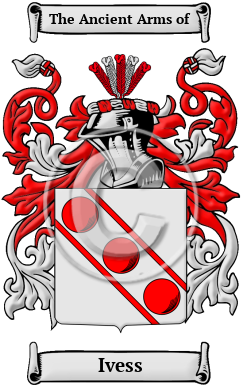
Show ContentsIvess History, Family Crest & Coats of Arms

Etymology of Ivess

What does the name Ivess mean?

Ivess is a name of ancient Norman origin. It arrived in England with the Norman Conquest of 1066. Ivess is a name that comes from the Norman given name Ivo, which contains the first element iv, which indicates that it is a reference to yew tree or one of its products such as the yew bow.

Early Origins of the Ivess family

The surname Ivess was first found in Lincolnshire where they held a family seat from very early times and were granted lands by Duke William of Normandy, their liege Lord, for their distinguished assistance at the Battle of Hastings in 1066 A.D.

Early History of the Ivess family

This web page shows only a small excerpt of our Ivess research. Another 82 words (6 lines of text) covering the years 1086, 1600 and 1662 are included under the topic Early Ivess History in all our PDF Extended History products and printed products wherever possible.

Ivess Spelling Variations

Anglo-Norman names are characterized by a multitude of spelling variations. When the Normans became the ruling people of England in the 11th century, they introduced a new language into a society where the main languages of Old and later Middle English had no definite spelling rules. These languages were more often spoken than written, so they blended freely with one another. Contributing to this mixing of tongues was the fact that medieval scribes spelled words according to sound, ensuring that a person's name would appear differently in nearly every document in which it was recorded. The name has been spelled Ives, Ivys and others.

Early Notables of the Ivess family

More information is included under the topic Early Ivess Notables in all our PDF Extended History products and printed products wherever possible.


Ivess migration to New Zealand +

Emigration to New Zealand followed in the footsteps of the European explorers, such as Captain Cook (1769-70): first came sealers, whalers, missionaries, and traders. By 1838, the British New Zealand Company had begun buying land from the Maori tribes, and selling it to settlers, and, after the Treaty of Waitangi in 1840, many British families set out on the arduous six month journey from Britain to Aotearoa to start a new life. Early immigrants include:

Ivess Settlers in New Zealand in the 19th Century
  • Patrick Ivess, aged 26, a shoemaker, who arrived in Nelson, New Zealand aboard the ship "Chile" in 1874


Houseofnames.com on Facebook
