| ![Show Contents]() Iraton History, Family Crest & Coats of Arms Iraton History, Family Crest & Coats of Arms
- Origins Available:
England
Etymology of IratonWhat does the name Iraton mean? The Anglo-Saxon name Iraton comes from when the family resided in Ireton, also known as Kirk Ireton, a parish, in the hundred of Wirksworth, in Derbyshire. In the same parish, Ireton-Wood is a township. 1 Collectively they date back to at least the Domesday Book of 1086 when they were known as Iretune 2 and literally meant "farmstead of the Irishmen." 3 "A parish in Derbyshire, which belonged to the family temp. Richard Coeurde-Lion. Henry, brother of Sewallis, Lord of Eatington, co. Warwick, ancestor of the noble family of Shirley, had a son Fulcher de Ireton, Lord of Ireton, direct ancestor of Henry Ireton, the son-in-law of Oliver Cromwell, whose father alienated Ireton in the reign of Elizabeth." 4 Early Origins of the Iraton familyThe surname Iraton was first found in Derbyshire but we must look to Lincolnshire for the first records of the family. It is here that Richard and Henry de Irton were listed in the Assize Rolls of 1218 and later in the Assize Rolls for Staffordshire in 1272. William de Yrton was recorded in the Assize Rolls for Lincolnshire in 1351. 5 The Hundredorum Rolls of 1273 included mention of William de Irton as holding lands in Yorkshire at that time and of Stephen de Irtone in Derbyshire. 6 Ralph Ireton (d. 1292), was Bishop of Carlisle, and "was a member of a family that took its name from the village of Irton, near Ravenglass in Cumberland, where it held estates that remained in its possession until the eighteenth century. A pedigree in Hutchinson's 'Cumberland' makes him the son of Stephen Irton, and assigns him two brothers, Robert and Thomas. Ralph Ireton became a canon regular of the order of St. Augustine, at the priory of Gisburne in Cleveland." 7 Early History of the Iraton familyThis web page shows only a small excerpt of our Iraton research. Another 135 words (10 lines of text) covering the years 1531, 1559, 1605, 1610, 1611, 1615, 1619, 1651, 1658, 1662, 1685, 1689, 1720 and 1769 are included under the topic Early Iraton History in all our PDF Extended History products and printed products wherever possible. Iraton Spelling VariationsThe English language only became standardized in the last few centuries; therefore,spelling variations are common among early Anglo-Saxon names. As the form of the English language changed, even the spelling of literate people's names evolved. Iraton has been recorded under many different variations, including Ireton, Ireson and others. Early Notables of the Iraton familyRichard Ireton, High Sheriff of Cumberland in 1531; and Nathaniel Ireson (1685-1769), an English potter, architect and mason best known for his work around Wincanton in Somerset. Henry Ireton (1611-1651), regicide, baptised 3 Nov. 1611, was the eldest son of German Ireton of Attenborough, near Nottingham. "His father, who settled at Attenborough about 1605, was the younger brother of William Ireton of Little Ireton in Derbyshire. " 7 General...
Another 66 words (5 lines of text) are included under the topic Early Iraton Notables in all our PDF Extended History products and printed products wherever possible. Migration of the Iraton familyFor many English families, the political and religious disarray that shrouded England made the far away New World an attractive prospect. On cramped disease-ridden ships, thousands migrated to those British colonies that would eventually become Canada and the United States. Those hardy settlers that survived the journey often went on to make important contributions to the emerging nations in which they landed. Analysis of immigration records indicates that some of the first North American immigrants bore the name Iraton or a variant listed above: Edward and Elizabeth Ireson who settled in Boston Massachusetts in 1635; Peter Ireton, a servant sent to the "foreign plantations" from Bristol in 1658.
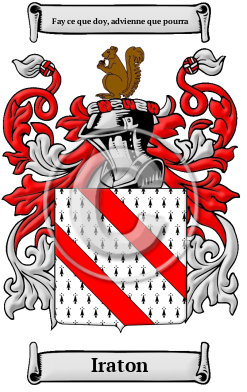
The motto was originally a war cry or slogan. Mottoes first began to be shown with arms in the 14th and 15th centuries, but were not in general use until the 17th century. Thus the oldest coats of arms generally do not include a motto. Mottoes seldom form part of the grant of arms: Under most heraldic authorities, a motto is an optional component of the coat of arms, and can be added to or changed at will; many families have chosen not to display a motto.
Motto: Fay ce que doy, advienne que pourra
Motto Translation: Do what you must, come what may.
- Lewis, Samuel, A Topographical Dictionary of England. Institute of Historical Research, 1848, Print.
- Williams, Dr Ann. And G.H. Martin, Eds., Domesday Book A Complete Translation. London: Penguin, 1992. Print. (ISBN 0-141-00523-8)
- Mills, A.D., Dictionary of English Place-Names. Oxford: Oxford University Press, 1991. Print. (ISBN 0-19-869156-4)
- Lower, Mark Anthony, Patronymica Britannica, A Dictionary of Family Names of the United Kingdom. London: John Russel Smith, 1860. Print.
- Reaney, P.H and R.M. Wilson, A Dictionary of English Surnames. London: Routledge, 1991. Print. (ISBN 0-415-05737-X)
- Bardsley, C.W, A Dictionary of English and Welsh Surnames: With Special American Instances. Wiltshire: Heraldry Today, 1901. Print. (ISBN 0-900455-44-6)
- Smith, George (ed), Dictionary of National Biography. London: Smith, Elder & Co., 1885-1900. Print
 |