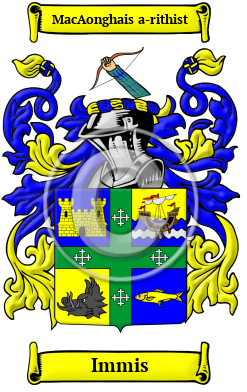
![Show Contents]() Immis History, Family Crest & Coats of Arms Immis History, Family Crest & Coats of Arms
- Origins Available:
Scotland
Ireland
Etymology of ImmisWhat does the name Immis mean? The sea-swept Hebrides islands and the west coast of Scotland, made up the ancient Dalriadan kingdom, the ancestral home of the Immis family. Their name comes from the personal name Angus. The Gaelic form of the name, Mac Aonguis, translates as son of Angus. Angus refers to the Pictish King Onnust who died in the year 761. While there are no direct links with this King in the history of the Clan or surname, there is a conjectural line, which may be adopted. The lands descended into the Barony of Innes in the County of Elginshire. However, the son or sons of Angus, originally from the Kingdom of Dalriada, were one of the three kindred houses, of the kingdom, the other two houses being the Gabran (the largest) and Lornetach which provided fighting men for the defense of the Kingdom of early Scots. For every twenty homes owned, they were obliged to provide two galleys, and so Angus, having 430 houses, provided a fleet of approximately forty galleys for the defense of the waters of Dalriada, generally those estuaries around the mouth of the Clyde. Early Origins of the Immis familyThe surname Immis was first found in Morven, their earliest known territory. In 1230, the Clan suffered from King Alexander II's campaign against Argyll. The Clan, however, retained their castle Kinlochaline, which stands upon strategic rock in Morvern. A massive castle by early standards, today it is in ruins. Early History of the Immis familyThis web page shows only a small excerpt of our Immis research. Another 156 words (11 lines of text) covering the years 1358 and 1890 are included under the topic Early Immis History in all our PDF Extended History products and printed products wherever possible. Immis Spelling VariationsMany spelling variations of Immis have been recorded over the years, including These are the result of the medieval practice of spelling according to sound and repeated translation between Gaelic and English. MacInnes, MacInnis, MacAngus and many more. Early Notables of the Immis familyMore information is included under the topic Early Immis Notables in all our PDF Extended History products and printed products wherever possible. Migration of the Immis family to IrelandSome of the Immis family moved to Ireland, but this topic is not covered in this excerpt.
Another 71 words (5 lines of text) about their life in Ireland is included in all our PDF Extended History products and printed products wherever possible. Migration of the Immis familyMany who arrived from Scotland settled along the east coast of North America in communities that would go on to become the backbones of the young nations of the United States and Canada. In the American War of Independence, many settlers who remained loyal to England went north to Canada as United Empire Loyalists. Their descendants later began to recover the lost Scottish heritage through events such as the highland games that dot North America in the summer months. Research into various historical records revealed some of first members of the Immis family emigrate to North America: Duncan McInnes, who settled in Philadelphia in 1798; Thomas and Helen McInnes, who settled in Boston in 1849; John McInnis who settled in South Carolina in 1716.
The motto was originally a war cry or slogan. Mottoes first began to be shown with arms in the 14th and 15th centuries, but were not in general use until the 17th century. Thus the oldest coats of arms generally do not include a motto. Mottoes seldom form part of the grant of arms: Under most heraldic authorities, a motto is an optional component of the coat of arms, and can be added to or changed at will; many families have chosen not to display a motto.
Motto: MacAonghais a-rithist
Motto Translation: Again MacInnes
 |