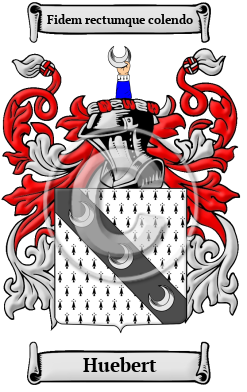
| ![Show Contents]() Huebert History, Family Crest & Coats of Arms Huebert History, Family Crest & Coats of Arms
Etymology of HuebertWhat does the name Huebert mean? Huebert is one of the many names that the Normans brought with them when they conquered England in 1066. The name Huebert came from the Norman personal name Hildebert, which is composed of the Germanic elements hild, which meant battle or strife, and berht, which meant bright or famous. One of the first records of the name was Hygbert, the Anglo-Saxon bishop of Lichfield. 1 Early Origins of the Huebert familyThe surname Huebert was first found in Cheshire where the Hibberts of Marple and Boirtles claim descent from Paganus Hubert, who accompanied King Richard I of England (Richard the Lionheart) in the Crusade of 1190. 1 The Hibberts of Marples and Birtles in Cheshire claim descent from Hubert of Curzon in Calvados, a Norman noble who was granted land in Cheshire and Nottingham. Early History of the Huebert familyThis web page shows only a small excerpt of our Huebert research. Another 147 words (10 lines of text) covering the years 1190, 1600, 1618, 1622, 1629, 1642, 1678, 1757, 1770, 1775, 1783, 1837 and 1849 are included under the topic Early Huebert History in all our PDF Extended History products and printed products wherever possible. Huebert Spelling VariationsThe English language only became standardized in the last few centuries. For that reason, spelling variations are common among many Anglo-Norman names. The shape of the English language was frequently changed with the introduction of elements of Norman French, Latin, and other European languages; even the spelling of literate people's names were subsequently modified. Huebert has been recorded under many different variations, including Hibbert, Hibart, Hibbard, Hibbart, Hibbet, Hibbets, Hibbett, Hibbotts, Hubert, Hubbert, Hubbard and many more. Early Notables of the Huebert familySir Francis Hubert (d. 1629), English poet, probably son of Edward Hubert, one of the six clerks in chancery. 2
Henry Hibbert (1600?-1678), English divine, born in Cheshire about 1600. In 1618 he entered Brasenose College, Oxford, and graduated B.A. on...
Another 40 words (3 lines of text) are included under the topic Early Huebert Notables in all our PDF Extended History products and printed products wherever possible. Migration of the Huebert family to IrelandSome of the Huebert family moved to Ireland, but this topic is not covered in this excerpt.
Another 49 words (4 lines of text) about their life in Ireland is included in all our PDF Extended History products and printed products wherever possible.
| Huebert migration to the United States | + |
To escape the uncertainty of the political and religious uncertainty found in England, many English families boarded ships at great expense to sail for the colonies held by Britain. The passages were expensive, though, and the boats were unsafe, overcrowded, and ridden with disease. Those who were hardy and lucky enough to make the passage intact were rewarded with land, opportunity, and social environment less prone to religious and political persecution. Many of these families went on to be important contributors to the young nations of Canada and the United States where they settled. Hueberts were some of the first of the immigrants to arrive in North America:
Huebert Settlers in United States in the 19th Century- Johanes Huebert, who landed in Allegany (Allegheny) County, Pennsylvania in 1866 3
- Francis Huebert, who landed in Allegany (Allegheny) County, Pennsylvania in 1867 3
- Adam Huebert, who landed in Allegany (Allegheny) County, Pennsylvania in 1870 3
- Anna Huebert, who arrived in Nebraska in 1874 3
- Girard Huebert, aged 37, who arrived in New York, NY in 1876 3
| Huebert migration to Canada | + |
Huebert Settlers in Canada in the 19th Century- Abram Huebert, who arrived in Manitoba in 1875
The motto was originally a war cry or slogan. Mottoes first began to be shown with arms in the 14th and 15th centuries, but were not in general use until the 17th century. Thus the oldest coats of arms generally do not include a motto. Mottoes seldom form part of the grant of arms: Under most heraldic authorities, a motto is an optional component of the coat of arms, and can be added to or changed at will; many families have chosen not to display a motto.
Motto: Fidem rectumque colendo
Motto Translation: By cultivating fidelity and rectitude.
- Lower, Mark Anthony, Patronymica Britannica, A Dictionary of Family Names of the United Kingdom. London: John Russel Smith, 1860. Print.
- Smith, George (ed), Dictionary of National Biography. London: Smith, Elder & Co., 1885-1900. Print
- Filby, P. William, Meyer, Mary K., Passenger and immigration lists index : a guide to published arrival records of about 500,000 passengers who came to the United States and Canada in the seventeenth, eighteenth, and nineteenth centuries. 1982-1985 Cumulated Supplements in Four Volumes Detroit, Mich. : Gale Research Co., 1985, Print (ISBN 0-8103-1795-8)
 |