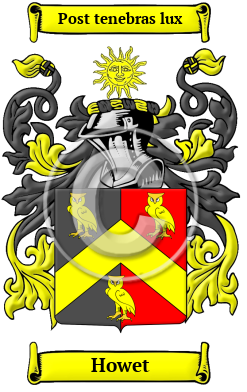
| ![Show Contents]() Howet History, Family Crest & Coats of Arms Howet History, Family Crest & Coats of Arms
- Origins Available:
England
Etymology of HowetWhat does the name Howet mean? The generations and branches of the Howet family share a name that has its roots in the ancient Anglo-Saxon culture of Britain. The name Howet comes from the personal name Hugh, which is supplemented by a form of the common diminutive suffix -et. The surname Howet is occasionally of local origin and was applied to someone who lived in a clearing. In this case, the name is derived from the Old English word hiewett, which means cutting, and referred in this instance to a place where trees had been cut down. Early Origins of the Howet familyThe surname Howet was first found in Yorkshire where they held a family seat from very ancient times, some say well before the Norman Conquest and the arrival of Duke William at Hastings in 1066 A.D. Early History of the Howet familyThis web page shows only a small excerpt of our Howet research. Another 84 words (6 lines of text) covering the years 1469 and 1691 are included under the topic Early Howet History in all our PDF Extended History products and printed products wherever possible. Howet Spelling VariationsUntil quite recently, the English language has lacked a definite system of spelling rules. Consequently, Anglo-Saxon surnames are characterized by a multitude of spelling variations. Changes in Anglo-Saxon names were influenced by the evolution of the English language, as it incorporated elements of French, Latin, and other languages. Although Medieval scribes and church officials recorded names as they sounded, so it is common to find one person referred to by several different spellings of his surname, even the most literate people varied the spelling of their own names. Variations of the name Howet include Howatt, Howat, Howet, Howett and others. Early Notables of the Howet familyMore information is included under the topic Early Howet Notables in all our PDF Extended History products and printed products wherever possible.
| Howet migration to the United States | + |
Searching for a better life, many English families migrated to British colonies. Unfortunately, the majority of them traveled under extremely harsh conditions: overcrowding on the ships caused the majority of the immigrants to arrive diseased, famished, and destitute from the long journey across the ocean. For those families that arrived safely, modest prosperity was attainable, and many went on to make invaluable contributions to the development of the cultures of the new colonies. Research into the origins of individual families in North America revealed records of the immigration of a number of people bearing the name Howet or a variant listed above:
Howet Settlers in United States in the 17th Century- John Howet, who settled in Virginia in 1652 with his wife
- John Howet, who arrived in Virginia in 1652 1
- William Howet, who settled in New England in 1685
Howet Settlers in United States in the 18th Century- Mary Howet, aged 25, who landed in New York in 1774 1
The motto was originally a war cry or slogan. Mottoes first began to be shown with arms in the 14th and 15th centuries, but were not in general use until the 17th century. Thus the oldest coats of arms generally do not include a motto. Mottoes seldom form part of the grant of arms: Under most heraldic authorities, a motto is an optional component of the coat of arms, and can be added to or changed at will; many families have chosen not to display a motto.
Motto: Post tenebras lux
Motto Translation: After darkness light.
- Filby, P. William, Meyer, Mary K., Passenger and immigration lists index : a guide to published arrival records of about 500,000 passengers who came to the United States and Canada in the seventeenth, eighteenth, and nineteenth centuries. 1982-1985 Cumulated Supplements in Four Volumes Detroit, Mich. : Gale Research Co., 1985, Print (ISBN 0-8103-1795-8)
 |