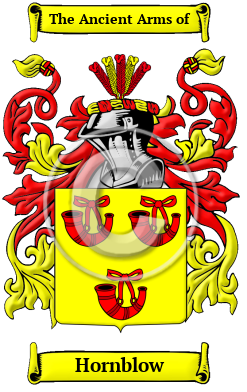
| ![Show Contents]() Hornblow History, Family Crest & Coats of Arms Hornblow History, Family Crest & Coats of Arms
- Origins Available:
England
Etymology of HornblowWhat does the name Hornblow mean? The Hornblow name was originally an Anglo-Saxon name that was given to a person who was employed as a hornblower. In the Middle Ages, workmen were often summoned to work by the blowing of a horn. The surname Hornblow is derived from the Old English word hornblawere, which means hornblower. 1 "In the Middle Ages workmen were called to work by the ringing of bells or by a horn. In 1320, at Caernarvon, Walter de la Grene was paid 1d. per week ‘for blowing the horn’ " 2 "Cornage is a law term (Latin cornagium) for a species of tenure in grand segjeanty, 'the service of which was to blow a horn when any invasion of the Scots was perceived; and by this tenure many persons held their lands northward, about the wall, commonly called the Pict's Wall.' The person who performed this duty for the lord, probably acquired the surname. At Ripon there prevails a peculiar custom, 'which according to some is of a date prior to the Conquest, viz., to blow a horn every night at nine o'clock; and formerly if any house or shop was robbed between that hour and sunrise the loss was made good to the sufferer, by a yearly tax of fourpence, imposed on every house-keeper. The tax is now discontinued, but the custom is still kept up of blowing the horn every night, three times at the mayor's door, and three times at the market-cross. The officer who performs this duty is called the Horn-blower.' " 3 Early Origins of the Hornblow familyThe surname Hornblow was first found in Essex, where John and Geoffrey le Homblauere were listed in 1255 and in the Assize Rolls for 1285. Adam Horneblawer was found in the Subsidy Rolls for Yorkshire in 1301. 2 The fictional courageous and a skilled seaman Horatio Hornblower is the protagonist in over twenty series of novels and stories by the English novelist, C.S. Forester (1899-1966). Early History of the Hornblow familyThis web page shows only a small excerpt of our Hornblow research. Another 113 words (8 lines of text) covering the years 1255, 1285, 1608, 1626, 1692, 1712, 1717, 1725, 1729, 1745, 1748, 1753, 1761, 1765, 1766, 1780 and 1809 are included under the topic Early Hornblow History in all our PDF Extended History products and printed products wherever possible. Hornblow Spelling VariationsOnly recently has spelling become standardized in the English language. As the English language evolved in the Middle Ages, the spelling of names changed also. The name Hornblow has undergone many spelling variations, including Hornblow, Hornblower, Horneblow, Horneblower and others. Early Notables of the Hornblow family- Jonathan Hornblower (1717-1780), engineer, belonged to a family which for two generations had shown much inventive genius. "His father, Joseph Hornblower (1692?-1761), born at Broseley, Shropshire, ma...
| Hornblow migration to Australia | + |
Hornblow Settlers in Australia in the 19th Century
| Hornblow migration to New Zealand | + |
Emigration to New Zealand followed in the footsteps of the European explorers, such as Captain Cook (1769-70): first came sealers, whalers, missionaries, and traders. By 1838, the British New Zealand Company had begun buying land from the Maori tribes, and selling it to settlers, and, after the Treaty of Waitangi in 1840, many British families set out on the arduous six month journey from Britain to Aotearoa to start a new life. Early immigrants include: Hornblow Settlers in New Zealand in the 19th Century- Sarah Hornblow, who arrived in Wellington, New Zealand aboard the ship "Cossipore" in 1857
| Contemporary Notables of the name Hornblow (post 1700) | + |
- Arthur Hornblow, American motion picture producer
- Harrison, Henry, Surnames of the United Kingdom: A Concise Etymological Dictionary Baltimore: Geneological Publishing Company, 2013. Print
- Reaney, P.H and R.M. Wilson, A Dictionary of English Surnames. London: Routledge, 1991. Print. (ISBN 0-415-05737-X)
- Lower, Mark Anthony, Patronymica Britannica, A Dictionary of Family Names of the United Kingdom. London: John Russel Smith, 1860. Print.
- Convict Records Voyages to Australia (Retrieved 14th July 2020). Retrieved from https://convictrecords.com.au/ships/atlas
 |