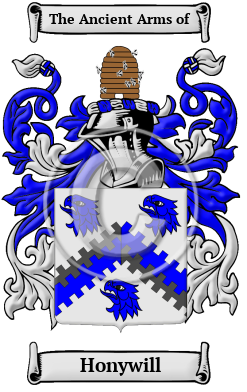
| ![Show Contents]() Honywill History, Family Crest & Coats of Arms Honywill History, Family Crest & Coats of Arms
- Origins Available:
England
Etymology of HonywillWhat does the name Honywill mean? The proud Honywill family originated in Cornwall, a rugged coastal region in southwestern England. In early times, people were known by only a single name. However, as the population grew and people traveled further afield, it became increasingly necessary to assume an additional name to differentiate between bearers of the same personal name. The manner in which hereditary surnames arose is interesting. Local surnames are derived from where the original bearer lived, was born, or held land. The Honywill family originally lived in Devon. Their name however, is derived from the Old English words hunig and welle, which means honey and well, respectively, and indicates that the original bearer lived near a spring or well where there was an abundance of honeycombs. Early Origins of the Honywill familyThe surname Honywill was first found in Devon, where they held a family seat from ancient times. Early History of the Honywill familyThis web page shows only a small excerpt of our Honywill research. Another 163 words (12 lines of text) covering the years 1500, 1524 and 1642 are included under the topic Early Honywill History in all our PDF Extended History products and printed products wherever possible. Honywill Spelling VariationsCornish surnames are characterized by a multitude of spelling variations. The frequent changes in surnames are due to the fact that the Old and Middle English languages lacked definite spelling rules. The official court languages, which were Latin and French, were also influential on the spelling of a surname. Since the spelling of surnames was rarely consistent in medieval times, and scribes and church officials recorded names as they sounded rather than adhering to any specific spelling rules, it was common to find the same individual referred to with different spellings of their surname in the ancient chronicles. Moreover, a large number of foreign names were brought into England, which accelerated and accentuated the alterations to the spelling of various surnames. Lastly, spelling variations often resulted from the linguistic differences between the people of Cornwall and the rest of England. The Cornish spoke a unique Brythonic Celtic language which was first recorded in written documents during the 10th century. However, they became increasingly Anglicized, and Cornish became extinct as a spoken language in 1777, although it has been revived by Cornish patriots in the modern era. The name has been spelled Honeywell, Honeywill, Honnywill, Honiwell and many more. Early Notables of the Honywill familyMore information is included under the topic Early Honywill Notables in all our PDF Extended History products and printed products wherever possible.
| Honywill migration to New Zealand | + |
Emigration to New Zealand followed in the footsteps of the European explorers, such as Captain Cook (1769-70): first came sealers, whalers, missionaries, and traders. By 1838, the British New Zealand Company had begun buying land from the Maori tribes, and selling it to settlers, and, after the Treaty of Waitangi in 1840, many British families set out on the arduous six month journey from Britain to Aotearoa to start a new life. Early immigrants include: Honywill Settlers in New Zealand in the 19th Century- Mr. Honywill, British settler travelling from Plymouth aboard the ship "Roman Emperor" arriving in Lyttlelton, Christchurch, South Island, New Zealand on 30th March 1863 1
- New Zealand Yesteryears Passenger Lists 1800 to 1900 (Retrieved 26th March 2019). Retrieved from http://www.yesteryears.co.nz/shipping/passlist.html
 |