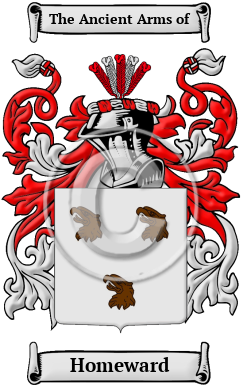
The surname Homeward was first found in Sussex where they held a family seat as Lords of the Manor. The Saxon influence of English history diminished after the Battle of Hastings in 1066. The language of the courts was French for the next three centuries and the Norman ambience prevailed. But Saxon surnames survived and the family name was first referenced in the year 1279 when William Homewood held estates in Sussex. The name was interchangeable with Homeward and Homeworth.
Early History of the Homeward family
This web page shows only a small excerpt of our Homeward research. Another 89 words (6 lines of text) covering the years 1296, 1455 and 1487 are included under the topic Early Homeward History in all our PDF Extended History products and printed products wherever possible.
Homeward Spelling Variations
It is only in the last few hundred years that the English language has been standardized. For that reason, early Anglo-Saxon surnames like Homeward are characterized by many spelling variations. As the English language changed and incorporated elements of other European languages, even literate people changed the spelling of their names. Scribes and monks in the Middle Ages spelled names they sounded, so it is common to find several variations that refer to a single person. The variations of the name Homeward include: Homewood, Holmewood, Homeward, Holmeward, Homeworth, Holmeworth, Homewood, Homward and many more.
Early Notables of the Homeward family
More information is included under the topic Early Homeward Notables in all our PDF Extended History products and printed products wherever possible.
Loading...
Loading...
Loading...
Loading...
Migration of the Homeward family
Many English families tired of political and religious strife left Britain for the new colonies in North America. Although the trip itself offered no relief - conditions on the ships were extremely cramped, and many travelers arrived diseased, starving, and destitute - these immigrants believed the opportunities that awaited them were worth the risks. Once in the colonies, many of the families did indeed prosper and, in turn, made significant contributions to the culture and economies of the growing colonies. An inquiry into the early roots of North American families has revealed a number of immigrants bearing the name Homeward or a variant listed above: James Homewood, who came to Maryland in 1649; Thomas Homewood, who settled in Maryland in 1650 with his wife; Josiah Boydell Homewood, who arrived in Philadelphia in 1846.