
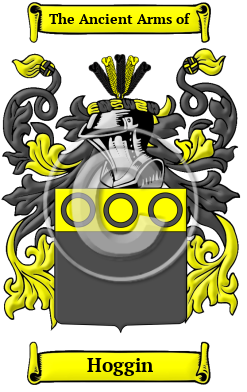
Show ContentsHoggin History, Family Crest & Coats of Arms

Etymology of Hoggin

What does the name Hoggin mean?

There are a multitude of ancient meanings and variations associated with the Irish surnames that are now common throughout the modern world. The original Gaelic form of the name Hoggin is Ó hÓgáin, meaning a descendant of Ógán’, a personal name derived from the Irish Gaelic word "og," which means "young."

Early Origins of the Hoggin family

The surname Hoggin was first found in County Tipperary (Irish: Thiobraid Árann), established in the 13th century in South-central Ireland, in the province of Munster where one of the first records of the name was Mathew O'Hogan a native of Ballyhogan and Dean of Killaloe who died in 1281. He held the position from 1267 until his death when he was interred in the Dominican convent at Limerick. Thus began the long line of O'Hogans who held lofty positions in the church. His successor was Maurice O'Hogan, who was consecrated in 1282 and governed his see for seventeen years until his death. Thomas O'Hogan, canon of Killaloe was consecrated bishop of the see in 1343 until his death in 1354.

Early History of the Hoggin family

This web page shows only a small excerpt of our Hoggin research. Another 67 words (5 lines of text) are included under the topic Early Hoggin History in all our PDF Extended History products and printed products wherever possible.

Hoggin Spelling Variations

Irish names recorded during the Middle Ages are characterized by many spelling variations. This preponderance of variations for common names can be explained by the fact that the scribes and church officials that kept records during that period individually decided how to capture one's name. These recorders primarily based their decisions on how the name was pronounced or what it meant. Research into the name Hoggin revealed many variations, including Hogan, O'Hogan, Hogen, Hoggin and others.

Early Notables of the Hoggin family

More information is included under the topic Early Hoggin Notables in all our PDF Extended History products and printed products wherever possible.


Hoggin migration to the United States +

A great wave of Irish migration occurred during the 19th century as a direct result of English colonial rule and tight-fisted absentee landlords. Many of these Irish immigrants boarded passenger ships bound for North America. Those who migrated early enough were given land in either British North America or the United States; those who came in the late 19th century were typically employed in industrial centers as laborers. At whatever age they undertook the dangerous passage to North America, those Irish immigrants were essential to the speedy development of the two infant nations to which they arrived, whether they broke and settled land, helped build canals, bridges, and railroads, or produced products for consumer consumption. An examination of immigration and passenger lists has uncovered a large number of immigrants bearing the name Hoggin or one of its variants:

Hoggin Settlers in United States in the 17th Century
  • Dennis Hoggin, aged 24, who arrived in Virginia in 1635 aboard the ship "Assurance" 1


  1. Filby, P. William, Meyer, Mary K., Passenger and immigration lists index : a guide to published arrival records of about 500,000 passengers who came to the United States and Canada in the seventeenth, eighteenth, and nineteenth centuries. 1982-1985 Cumulated Supplements in Four Volumes Detroit, Mich. : Gale Research Co., 1985, Print (ISBN 0-8103-1795-8)


Houseofnames.com on Facebook