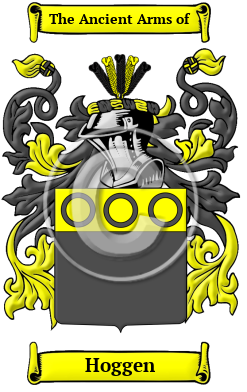
There are a multitude of ancient meanings and variations associated with the Irish surnames that are now common throughout the modern world. The original Gaelic form of the name Hoggen is Ó hÓgáin, meaning a descendant of Ógán’, a personal name derived from the Irish Gaelic word "og," which means "young."
Loading...
Early Origins of the Hoggen family
The surname Hoggen was first found in County Tipperary (Irish: Thiobraid Árann), established in the 13th century in South-central Ireland, in the province of Munster where one of the first records of the name was Mathew O'Hogan a native of Ballyhogan and Dean of Killaloe who died in 1281. He held the position from 1267 until his death when he was interred in the Dominican convent at Limerick. Thus began the long line of O'Hogans who held lofty positions in the church. His successor was Maurice O'Hogan, who was consecrated in 1282 and governed his see for seventeen years until his death. Thomas O'Hogan, canon of Killaloe was consecrated bishop of the see in 1343 until his death in 1354.
Early History of the Hoggen family
This web page shows only a small excerpt of our Hoggen research. Another 67 words (5 lines of text) are included under the topic Early Hoggen History in all our PDF Extended History products and printed products wherever possible.
Hoggen Spelling Variations
The spelling of one's surname was not as important as it is today. Names were recorded as they sounded and in many cases, one's surname changed with each listing. As a result, surnames often had many spelling variations. For Hoggen some of these variations included: Hogan, O'Hogan, Hogen, Hoggin and others.
Early Notables of the Hoggen family
More information is included under the topic Early Hoggen Notables in all our PDF Extended History products and printed products wherever possible.
Loading...
Loading...
Loading...
Loading...
Migration of the Hoggen family
Irish families fled the English-colonized Ireland in record numbers during the 19th century for North America. Many of those destitute families died from disease during, and even shortly after, the long journey. Although those that immigrated before the Great Potato Famine of the 1840s often were granted a tract of land, those that arrived later were generally accommodated in urban centers or in work camps. Those in the urban centers would labor in the manufacturing sector, whereas those in work camps would to build critical infrastructures such as bridges, canals, roads, and railways. Regardless of when these Irish immigrants came to North America, they were critical for the rapid development of the young nations of the United States and Canada. Early immigration and passenger lists have recorded many early immigrants bearing the name of Hoggen: Sebastian Hogan settled in New England in 1764; Daniel, David, Denis, Edward, James, John, Michael, Patrick, Robert, Thomas and William Hogan, all arrived in Pennsylvania between 1840 and 1870..