| ![Show Contents]() Hockman History, Family Crest & Coats of Arms Hockman History, Family Crest & Coats of Arms
- Origins Available:
England
Etymology of HockmanWhat does the name Hockman mean? The distinguished surname Hockman emerged among the industrious people of Flanders, which was an important trading partner and political ally of Britain during the Middle Ages. As a result of the frequent commercial intercourse between the Flemish and English nations, many Flemish migrants settled in Britain. In early times, people were known by only a single name. However, as the population grew and people traveled further afield, it became increasingly necessary to assume an additional name to differentiate between bearers of the same personal name. One of the most common classes of surname is the patronymic surname, which was usually derived from the first name of the person's father. Flemish surnames of this type are often characterized by the diminutive suffix -kin, which became very frequent in England during the 14th century. The surname Hockman is derived from Hocc, a pet form of the Old English personal name Hocca. This pet form is supplemented by the diminutive suffix -el. 1 Another source claims "the Hokings, according to Ferguson, were a Frisian people, and derived their name from one Hoce, mentioned in the poem of Beowulf." 2 And another source notes "Hawkins, Hockin, and Hocking are familiar Cornish variants of Hawkin." 3 Early Origins of the Hockman familyThe surname Hockman was first found in Cornwall, England where the first record of the family was Robery Hokyn who was listed on the Ministers' Accounts of the Earldom of Cornwall in 1297. A few years later, John Hokyn was listed in the Subsidy Rolls of Suffolk in 1327. Many years later, Christopher Hockins and Abel Hockinge were listed on the Protestant Returns for Devon in 1642. 1 "There are two gentlemen's seats in the parish of [Lewannick, Cornwall], both of which are ancient; Trewanta Hall, the residence of William Hocken, Esq. and Treliske or Trelaske, the property and abode of Samuel Archer, Esq." 4 Early History of the Hockman familyThis web page shows only a small excerpt of our Hockman research. Another 108 words (8 lines of text) covering the year 1591 is included under the topic Early Hockman History in all our PDF Extended History products and printed products wherever possible. Hockman Spelling VariationsFlemish surnames are characterized by a large number of spelling variations. One reason for this is that medieval English lacked definite spelling rules. The spellings of surnames were also influenced by the official court languages, which were French and Latin. Names were rarely spelled consistently in medieval times. Scribes and church officials recorded names as they sounded, rather than adhering to specific spelling rules, and people often had their names registered in several different forms throughout their lives. One of the greatest reasons for change is the linguistic uniqueness of the Flemish settlers in England, who spoke a language closely related to Dutch. The pronunciation and spelling of Flemish names were often altered to suit the tastes of English-speaking people. In many cases, the first, final, or middle syllables of surnames were eliminated. The name has been spelled Hocking, Hockin, Hockings, Hockins, Hokings and many more. Early Notables of the Hockman familyMore information is included under the topic Early Hockman Notables in all our PDF Extended History products and printed products wherever possible. Hockman RankingIn the United States, the name Hockman is the 13,038th most popular surname with an estimated 2,487 people with that name. 5
| Hockman migration to the United States | + |
A search of the immigration and passenger lists has shown a number of people bearing the name Hockman:
Hockman Settlers in United States in the 19th Century- B. Hockman, aged 47, German settler who arrived in New York aboard the ship "Marianna" in 1847 6
- Betsy Hockman, aged 22, British settler who arrived in New York aboard the ship "Liverpool" in 1849 6
- Peter Hockman, aged 19, British settler who arrived in New York aboard the ship "Kate Howe" in 1850 6
- L. Hockman, aged 21, German settler who arrived in New York aboard the ship "Constellation" in 1852 6
- H. Hockman, aged 27, Dutch settler who arrived in New York aboard the ship "Seoupool" in 1866 6
- ... (More are available in all our PDF Extended History products and printed products wherever possible.)
| Hockman migration to Australia | + |
Hockman Settlers in Australia in the 18th Century- Mr. William Hockman, English convict who was convicted in Middlesex, England for 7 years, transported aboard the "Barwell" in September 1797, arriving in New South Wales, Australia 7
Hockman Settlers in Australia in the 20th Century- Mr. Hockman, British settler who arrived in Fremantle, Australia aboard the ship "Orsova" in 1915 8
- Mrs. Hockman, British settler who arrived in Fremantle, Australia aboard the ship "Orsova" in 1915 8
| Contemporary Notables of the name Hockman (post 1700) | + |
- Tanya Hockman, American athletic director and coach of women's volleyball at Malone University in Canton, Ohio
- Ronald Lashley Hockman (b. 1924), American Democratic Party politician, Member of West Virginia State House of Delegates from Tucker County, 1959-60 9
- Peachy L. Hockman, American Republican politician, Alternate Delegate to Republican National Convention from Virginia, 1948 10
- Elmo Hockman, American Libertarian politician, Candidate for Texas State House of Representatives 81st District, 2008 10
- D. Hockman, American politician, Candidate for Presidential Elector for Ohio, 1928 10
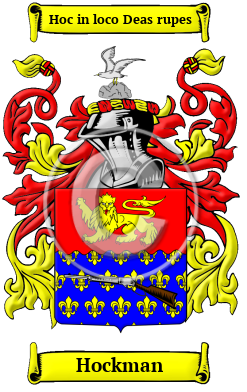
The motto was originally a war cry or slogan. Mottoes first began to be shown with arms in the 14th and 15th centuries, but were not in general use until the 17th century. Thus the oldest coats of arms generally do not include a motto. Mottoes seldom form part of the grant of arms: Under most heraldic authorities, a motto is an optional component of the coat of arms, and can be added to or changed at will; many families have chosen not to display a motto.
Motto: Hoc in loco Deas rupes
Motto Translation: Here God is a rock.
- Reaney, P.H and R.M. Wilson, A Dictionary of English Surnames. London: Routledge, 1991. Print. (ISBN 0-415-05737-X)
- Lower, Mark Anthony, Patronymica Britannica, A Dictionary of Family Names of the United Kingdom. London: John Russel Smith, 1860. Print.
- Bardsley, C.W, A Dictionary of English and Welsh Surnames: With Special American Instances. Wiltshire: Heraldry Today, 1901. Print. (ISBN 0-900455-44-6)
- Hutchins, Fortescue, The History of Cornwall, from the Earliest Records and Traditions to the Present Time. London: William Penaluna, 1824. Print
- "What are the 5,000 Most Common Last Names in the U.S.?". NameCensus.com, https://namecensus.com/last-names/
- Ellis Island Search retrieved 21st October 2021. Retrieved from https://heritage.statueofliberty.org/passenger-result
- Convict Records Voyages to Australia (Retrieved 29th September 2020). Retrieved from https://convictrecords.com.au/ships/barwell
- National Archives of Australia retrieved 21st October 2021. Retrieved from https://recordsearch.naa.gov.au
- The Political Graveyard: Alphabetical Name Index. (Retrieved 2015, October 9) . Retrieved from http://politicalgraveyard.com/alpha/index.html
 |