| ![Show Contents]() Hippesley History, Family Crest & Coats of Arms Hippesley History, Family Crest & Coats of Arms
- Origins Available:
England
Etymology of HippesleyWhat does the name Hippesley mean? In ancient Anglo-Saxon England, the ancestors of the Hippesley surname lived in Warwickshire, at Ipsley, a parish, in the union of Alcester, Alcester division of the hundred of Barlichway. 1 The place-name Ipsley is composed of two Old English elements. The first is the word yppe, which meant "upland, high place." The second is leah, which meant "forest clearing." The place-name as a whole means "forest clearing on an upland; clearing in a high place." 2 Early Origins of the Hippesley familyThe surname Hippesley was first found in Warwickshire where (Holes) de Ippesleye was recorded 20 Edward I (during the twentieth year of King Edward I's reign). 3 Early History of the Hippesley familyThis web page shows only a small excerpt of our Hippesley research. Another 58 words (4 lines of text) covering the years 1748 and 1825 are included under the topic Early Hippesley History in all our PDF Extended History products and printed products wherever possible. Hippesley Spelling VariationsIt is only in the last few hundred years that the English language has been standardized. For that reason, early Anglo-Saxon surnames like Hippesley are characterized by many spelling variations. As the English language changed and incorporated elements of other European languages, even literate people changed the spelling of their names. The variations of the name Hippesley include: Hippisley, Hippesley, Hippsley, Hipsey, Hipsley and others. Early Notables of the Hippesley familyJohn Hippisley (d. 1748), English actor and dramatist, "born near Wookey Hole in Somersetshire. He seems to have belonged to a well-known Somerset family. He is said in the ‘Biographia Dramatica’ to have first come on the stage as a candle-snuffer, and on the death of Pinkethman to have succeeded to his parts." 4
Sir John...
Another 54 words (4 lines of text) are included under the topic Early Hippesley Notables in all our PDF Extended History products and printed products wherever possible.
| Hippesley migration to Australia | + |
Emigration to Australia included the Third Fleet of convicts, tradespeople and early settlers. Early immigrants include: Third Fleet - Miss Elizabeth Hippesley, (b. 1756), aged 31, English settler convicted in London on 23rd February 1785, sentenced for 7 years for theft, transported aboard the ship "Lady Penrhyn" leaving in 1787 arriving in New South Wales, Australia in 1788 5
| Hippesley migration to New Zealand | + |
Emigration to New Zealand followed in the footsteps of the European explorers, such as Captain Cook (1769-70): first came sealers, whalers, missionaries, and traders. By 1838, the British New Zealand Company had begun buying land from the Maori tribes, and selling it to settlers, and, after the Treaty of Waitangi in 1840, many British families set out on the arduous six month journey from Britain to Aotearoa to start a new life. Early immigrants include: Hippesley Settlers in New Zealand in the 19th Century- William Frederick Hippesley, who arrived in Nelson, New Zealand aboard the ship "Sir Charles Forbes" in 1842
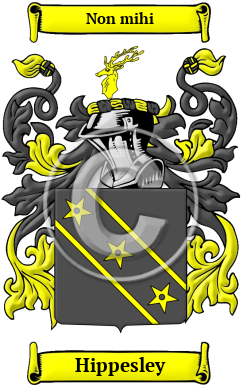
The motto was originally a war cry or slogan. Mottoes first began to be shown with arms in the 14th and 15th centuries, but were not in general use until the 17th century. Thus the oldest coats of arms generally do not include a motto. Mottoes seldom form part of the grant of arms: Under most heraldic authorities, a motto is an optional component of the coat of arms, and can be added to or changed at will; many families have chosen not to display a motto.
Motto: Non mihi
Motto Translation: Not for myself.
- Lewis, Samuel, A Topographical Dictionary of England. Institute of Historical Research, 1848, Print.
- Mills, A.D., Dictionary of English Place-Names. Oxford: Oxford University Press, 1991. Print. (ISBN 0-19-869156-4)
- Bardsley, C.W, A Dictionary of English and Welsh Surnames: With Special American Instances. Wiltshire: Heraldry Today, 1901. Print. (ISBN 0-900455-44-6)
- Smith, George (ed), Dictionary of National Biography. London: Smith, Elder & Co., 1885-1900. Print
- Convict Records of Australia. Retrieved 4th February 2021 from https://convictrecords.com.au/ships
 |