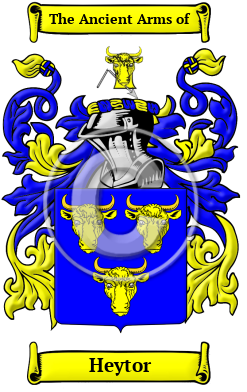
| ![Show Contents]() Heytor History, Family Crest & Coats of Arms Heytor History, Family Crest & Coats of Arms
- Origins Available:
England
Etymology of HeytorWhat does the name Heytor mean? Cornwall in southwestern England provides the original birthplace of the surname Heytor. As populations grew, people began to assume an extra name to avoid confusion and to further identify themselves. Unlike most Celtic peoples, who favored patronymic names, the Cornish predominantly used local surnames. This was due to the heavy political and cultural influence of the English upon the Cornish People at the time that surnames first came into use. Local surnames were derived from where a person lived, held land, or was born. While many Cornish surnames of this sort appear to be topographic surnames, which were given to people who resided near physical features such as hills, streams, churches, or types of trees, many are actually habitation surnames derived from lost or unrecorded place names. The name Heytor history began in Devon. Their name, however, is derived from the Old English word heah, which means hill or raised land. 1 Early Origins of the Heytor familyThe surname Heytor was first found in Devon, where they held a family seat from ancient times. Early in their history the family branched to Cambridgeshire, where William Haytere was registered in the Assize Rolls of 1260. There was also registry of Reginald le Heytur in 1296. 2 John Haytour was listed in Somerset 1 Edward III (during the first years of Edward III's reign.) 3 Early History of the Heytor familyThis web page shows only a small excerpt of our Heytor research. Another 99 words (7 lines of text) covering the years 1540, 1611, 1628, 1632, 1634, 1637, 1684, 1687, 1702, 1706, 1726, 1728, 1760 and 1762 are included under the topic Early Heytor History in all our PDF Extended History products and printed products wherever possible. Heytor Spelling VariationsCornish surnames are characterized by a multitude of spelling variations. The frequent changes in surnames are due to the fact that the Old and Middle English languages lacked definite spelling rules. The official court languages, which were Latin and French, were also influential on the spelling of a surname. Since the spelling of surnames was rarely consistent in medieval times, and scribes and church officials recorded names as they sounded rather than adhering to any specific spelling rules, it was common to find the same individual referred to with different spellings of their surname in the ancient chronicles. Moreover, a large number of foreign names were brought into England, which accelerated and accentuated the alterations to the spelling of various surnames. Lastly, spelling variations often resulted from the linguistic differences between the people of Cornwall and the rest of England. The Cornish spoke a unique Brythonic Celtic language which was first recorded in written documents during the 10th century. However, they became increasingly Anglicized, and Cornish became extinct as a spoken language in 1777, although it has been revived by Cornish patriots in the modern era. The name has been spelled Hayter, Haiter, Haytor, Hater and others. Early Notables of the Heytor familyRichard Hayter (1611?-1684), English theological writer, born about 1611, son of William Hayter, fishmonger, of Salisbury, Wiltshire. In 1628 he entered Magdalen Hall, Oxford, as a commoner, and graduated B.A. 26 April 1632, and M.A. 29 Jan. 1634. 4
Thomas Hayter (1702-1762), was bishop successively of Norwich and London, baptised at Chagford, Devonshire, 17 Nov. 1702, was eldest son (of ten...
Another 59 words (4 lines of text) are included under the topic Early Heytor Notables in all our PDF Extended History products and printed products wherever possible. Migration of the Heytor familyA search of the immigration and passenger lists has shown a number of people bearing the name Heytor: George Hayter, who sailed to Barbados between 1654 and 1663. In addition, John Hayter had settled in Tilton, Newfoundland by 1771; and John Haiter was recorded as a planter in Trinity, Newfoundland in 1830..
- Lower, Mark Anthony, Patronymica Britannica, A Dictionary of Family Names of the United Kingdom. London: John Russel Smith, 1860. Print.
- Reaney, P.H and R.M. Wilson, A Dictionary of English Surnames. London: Routledge, 1991. Print. (ISBN 0-415-05737-X)
- Dickinson, F.H., Kirby's Quest for Somerset of 16th of Edward the 3rd London: Harrison and Sons, Printers in Ordinary to Her Majesty, St, Martin's Lane, 1889. Print.
- Smith, George (ed), Dictionary of National Biography. London: Smith, Elder & Co., 1885-1900. Print
 |