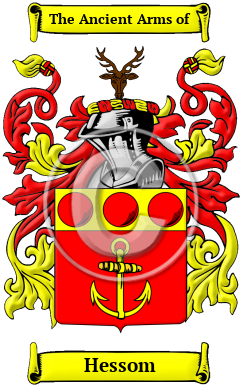
| ![Show Contents]() Hessom History, Family Crest & Coats of Arms Hessom History, Family Crest & Coats of Arms
- Origins Available:
England
Etymology of HessomWhat does the name Hessom mean? Hessom is an ancient Anglo-Saxon name that is derived from the son of Heysham.In Old English, patronyms were formed by adding a variety of suffixes to personal names, which changed over time and from place to place. For example, after the Norman Conquest, sunu and sune, which meant son, were the most common patronymic suffixes. In the 12th and 13th centuries, the most common patronymic names included the word filius, which meant son. By the 14th century, the suffix son had replaced these earlier versions. Surnames that were formed with filius or son were more common in the north of England and it was here that the number of individuals without surnames was greatest at this time. Early Origins of the Hessom familyThe surname Hessom was first found in Lancashire, at Heysham, a coastal village near Lancaster. The village dates back to the Domesday Book 1 when it was listed there as Hessam derived from the Old English words haes + ham and meant "homestead or village among the brushwood" 2 "Under the Normans, the manor of Heysham, anciently Hessam, was held by the service of cornage, where the lord was bound by his tenure to meet the king on the borders of the county, with his horn and a white wand, introducing him into the county, and attending him on his departure. From this tenure, it is probable that a branch of the family, de Hessam." 3 Today the village is a thriving community, but historically the ancient St. Patrick's Chapel, close to St. Peter's Church holds stone graves in the ruins and is home to many Saxon and Viking remains. The church itself contains an ancient Viking hogback stone. According to legend, St. Patrick landed here after crossing from Ireland and established the chapel. Early History of the Hessom familyThis web page shows only a small excerpt of our Hessom research. Another 147 words (10 lines of text) covering the years 1086, 1682, 1697, 1700, 1702, 1704, 1714, 1723, 1724, 1733 and 1738 are included under the topic Early Hessom History in all our PDF Extended History products and printed products wherever possible. Hessom Spelling VariationsHessom has been spelled many different ways. Before English spelling became standardized over the last few hundred years, spelling variations in names were a common occurrence. As the English language changed in the Middle Ages, absorbing pieces of Latin and French, as well as other languages, the spelling of people's names also changed considerably, even over a single lifetime. Many variations of the name Hessom have been found, including Heysham, Haysom, Hessam, Heshen and others. Early Notables of the Hessom familyRichard Helsham (1682?-1738), "friend of Swift, was born probably in 1682 at Leggatsrath, co. Kilkenny. He was educated at Kilkenny College, entered Trinity College, Dublin, 18 July 1697, obtained a scholarship in 1700, graduated B.A. in 1702, was elected fellow in 1704, and was co-opted a senior fellow in 1714. He was lecturer in mathematics 1723-30, and was the first to hold the professorship of natural philosophy on the foundation of Erasmus Smith...
Another 73 words (5 lines of text) are included under the topic Early Hessom Notables in all our PDF Extended History products and printed products wherever possible.
| Hessom migration to New Zealand | + |
Emigration to New Zealand followed in the footsteps of the European explorers, such as Captain Cook (1769-70): first came sealers, whalers, missionaries, and traders. By 1838, the British New Zealand Company had begun buying land from the Maori tribes, and selling it to settlers, and, after the Treaty of Waitangi in 1840, many British families set out on the arduous six month journey from Britain to Aotearoa to start a new life. Early immigrants include: Hessom Settlers in New Zealand in the 19th Century- Mr. Hessom, British settler travelling from London aboard the ship "Royal Stuart" arriving in Auckland, New Zealand in 1855 4
- Williams, Dr Ann. And G.H. Martin, Eds., Domesday Book A Complete Translation. London: Penguin, 1992. Print. (ISBN 0-141-00523-8)
- Mills, A.D., Dictionary of English Place-Names. Oxford: Oxford University Press, 1991. Print. (ISBN 0-19-869156-4)
- Lewis, Samuel, A Topographical Dictionary of England. Institute of Historical Research, 1848, Print.
- New Zealand Yesteryears Passenger Lists 1800 to 1900 (Retrieved 26th March 2019). Retrieved from http://www.yesteryears.co.nz/shipping/passlist.html
 |