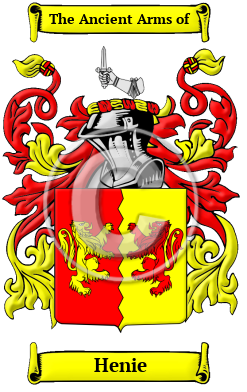
The Irish surnames in use today are underpinned by a multitude of rich histories. The name Henie originally appeared in Gaelic as Ó hEighnigh. 1
Loading...
Early Origins of the Henie family
The surname Henie was first found in County Londonderry (Irish: Doire), a Northern Irish county also known as Derry, in the province of Ulster, where they held a family seat from ancient times.
Early History of the Henie family
This web page shows only a small excerpt of our Henie research. Another 91 words (6 lines of text) are included under the topic Early Henie History in all our PDF Extended History products and printed products wherever possible.
Henie Spelling Variations
In the Middle Ages many people were recorded under different spellings each time their name was written down. Research on the Henie family name revealed numerous spelling variations, including Heaney, Heany, Hegney, Hegeany, Heagney, Heeney and others.
Early Notables of the Henie family
More information is included under the topic Early Henie Notables in all our PDF Extended History products and printed products wherever possible.
Loading...
Loading...
Loading...
Loading...
Migration of the Henie family
A massive wave of Irish immigrants hit North America during the 19th century. Although many early Irish immigrants made a carefully planned decision to leave left Ireland for the promise of free land, by the 1840s immigrants were fleeing a famine stricken land in desperation. The condition of Ireland during the Great Potato Famine of the late 1840s can be attributed to a rapidly expanding population and English imperial policies. Those Irish families that arrived in North America were essential to its rapid social, industrial, and economic development. Passenger and immigration lists have revealed a number of early Irish immigrants bearing the name Henie: Charles, Daniel, Hugh, James, John, Patrick, Samuel and Thomas Heaney all arrived in Philadelphia between 1840 and 1860; Bernard, James, John, Mathew, Nicholas and Phillip Heany arrived in Philadelphia between 1840 and 1860..