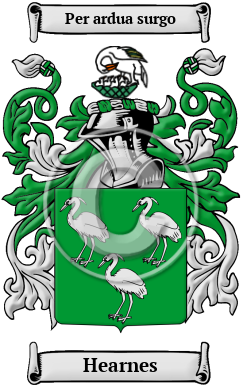
| ![Show Contents]() Hearnes History, Family Crest & Coats of Arms Hearnes History, Family Crest & Coats of Arms
Etymology of HearnesWhat does the name Hearnes mean? Many Irish surnames can be traced back to their Gaelic forms. The name Hearnes originally appeared in Gaelic as Ó hEachthigheirn or Ó hEachthigheirna, made up of the words "each" meaning "steed," and "thighearna," meaning "lord." This was first Anglicized O'Hagherin, which was later changed to O'Aherne before the prefix was eventually dropped. 1 Early Origins of the Hearnes familyThe surname Hearnes was first found in County Clare (Irish: An Clár) located on the west coast of Ireland in the province of Munster, where they held a family seat as a Dalcassian sept from before the year 1000. However, with the disruptions of the Strongbow Invasion of 1172, they migrated southward to counties Cork and Waterford. In Waterford the name is predominantly Hearn and Hearne. Early History of the Hearnes familyThis web page shows only a small excerpt of our Hearnes research. Another 116 words (8 lines of text) covering the years 1420, 1566, 1754, 1769, 1797 and 1806 are included under the topic Early Hearnes History in all our PDF Extended History products and printed products wherever possible. Hearnes Spelling VariationsMany variations of the name Hearnes were found in archives from the Middle Ages. The spelling and language in which the people's names were recorded was often up to the individual scribe. Variations of the name Hearnes found include O'Aherne, O'Ahern, Hearne, O'Heffron, Haveran, Hayveren and many more. Early Notables of the Hearnes familyMore information is included under the topic Early Hearnes Notables in all our PDF Extended History products and printed products wherever possible.
| Hearnes migration to New Zealand | + |
Emigration to New Zealand followed in the footsteps of the European explorers, such as Captain Cook (1769-70): first came sealers, whalers, missionaries, and traders. By 1838, the British New Zealand Company had begun buying land from the Maori tribes, and selling it to settlers, and, after the Treaty of Waitangi in 1840, many British families set out on the arduous six month journey from Britain to Aotearoa to start a new life. Early immigrants include: Hearnes Settlers in New Zealand in the 19th Century- Patrick Hearnes, who arrived in Auckland, New Zealand aboard the ship "Armstrong" in 1865
| Contemporary Notables of the name Hearnes (post 1700) | + |
- Betty Sue Hearnes (1927-2023), née Cooper, American Democratic politician from Missouri, Member of the Missouri House of Representatives (1979-1989), First Lady of Missouri (1965-1973)
- Warren E. Hearnes (1923-2009), American Democratic Party politician, Member of Missouri State House of Representatives, 1950-61; Secretary of State of Missouri, 1961-65; Governor of Missouri, 1965-73 2
- Howard Hearnes Carwile (1911-1987), American lawyer and politician
The motto was originally a war cry or slogan. Mottoes first began to be shown with arms in the 14th and 15th centuries, but were not in general use until the 17th century. Thus the oldest coats of arms generally do not include a motto. Mottoes seldom form part of the grant of arms: Under most heraldic authorities, a motto is an optional component of the coat of arms, and can be added to or changed at will; many families have chosen not to display a motto.
Motto: Per ardua surgo
Motto Translation: I rise through difficulties.
- MacLysaght, Edward, Irish Families Their Names, Arms and Origins 4th Edition. Dublin: Irish Academic, 1982. Print. (ISBN 0-7165-2364-7)
- The Political Graveyard: Alphabetical Name Index. (Retrieved 2015, November 2) . Retrieved from http://politicalgraveyard.com/alpha/index.html
 |