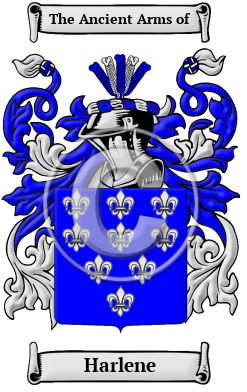
| ![Show Contents]() Harlene History, Family Crest & Coats of Arms Harlene History, Family Crest & Coats of Arms
- Origins Available:
England
Early Origins and Etymology of HarleneThe surname Harlene was first found in Norfolk at Harling, a parish that dates back to Saxon times when it was known as Herlinge c. 1060. 1 2 And it is here that we find the first record of the family, namely Balduinus filius Herluini in 1066. 3 A few years later, the parish would appear as Herlinga in the Domesday Book of 1086. At that time, the parish consisted of a village with a church, two mills, fisheries, a beehive, and 180 sheep. The Domesday Book has two listings for the family: Herluinus and Urleuuine. 4 The village of Harling on the River Thet in the middle centuries later became two, East Harling and West Harling. The holders of the land in 1086 were Godric, Ingulf, and Robert de Verly. Over one hundred years later in Kent, Herlewine de Sumerfeld was listed there in the Pipe Rolls of 1191. Later in Kent, John Erlewin was recorded in 1225 and later, Roger Herlewyn was found in the Pipe Rolls for Dorset in 1230. In Sussex, William Harlyn was recorded in the Subsidy Rolls for 1327. Alice Hurlewyne was registered in the Subsidy Rolls for Surrey in 1332. 3 The Hundredorum Rolls of 1273 listed Herlewinus (without surname), Norfolk; Henry Herlewine, Kent; Thomas Herlewine, Lincolnshire; and John Herlewyn, Buckinghamshire. 5 In Somerset, Stephen Harlwyn was recorded 1 Edward III (during the first year of the reign of King Edward III) 6 and in Yorkshire, Agnes Herlyng was found in the Yorkshire Poll Tax Rolls of 1379. 5 Early History of the Harlene familyThis web page shows only a small excerpt of our Harlene research. Another 105 words (8 lines of text) covering the years 1435, 1460 and 1600 are included under the topic Early Harlene History in all our PDF Extended History products and printed products wherever possible. Harlene Spelling VariationsAnglo-Norman names are characterized by a multitude of spelling variations. When the Normans became the ruling people of England in the 11th century, they introduced a new language into a society where the main languages of Old and later Middle English had no definite spelling rules. These languages were more often spoken than written, so they blended freely with one another. Contributing to this mixing of tongues was the fact that medieval scribes spelled words according to sound, ensuring that a person's name would appear differently in nearly every document in which it was recorded. The name has been spelled Harlin, Harling, Harlan, Hawlin, Harlingham and others. Early Notables of the Harlene familySir Robert de Harling (d. 1435), English landed gentry, a soldier, and political strongman. The Norfolk villages of East Harling, West Harling, Harling Market and Larling were greatly under his control.
A manuscript above, signed by "Spencer Sparrow, Churchwarden", says he was "...a man noble in feat of arms. His family flourished well known (sic) among many of its natives of France - at length mangled by force of arms. He died at Paris. He fell in the year one thousand four hundred and thirty five on the feast of Gregory" - i.e., 9th September 1435.
It would appear that the...
Another 185 words (13 lines of text) are included under the topic Early Harlene Notables in all our PDF Extended History products and printed products wherever possible. Migration of the Harlene familyFor many English families, the political and religious disarray that plagued their homeland made the frontiers of the New World an attractive prospect. Thousands migrated, aboard cramped disease-ridden ships. They arrived sick, poor, and hungry, but were welcomed in many cases with far greater opportunity than at home in England. Many of these hardy settlers went on to make important contributions to the emerging nations in which they landed. Among early immigrants bearing the name Harlene or a variant listed above were: Thomas Harlin who settled in New Jersey in 1773; Edward Harlin landed in Philadelphia, Pennsylvania in 1802; James, John and Thomas Harlin settled in Philadelphia, Pennsylvania between 1772 and 1847.
- Mills, A.D., Dictionary of English Place-Names. Oxford: Oxford University Press, 1991. Print. (ISBN 0-19-869156-4)
- Lower, Mark Anthony, Patronymica Britannica, A Dictionary of Family Names of the United Kingdom. London: John Russel Smith, 1860. Print.
- Reaney, P.H and R.M. Wilson, A Dictionary of English Surnames. London: Routledge, 1991. Print. (ISBN 0-415-05737-X)
- Williams, Dr Ann. And G.H. Martin, Eds., Domesday Book A Complete Translation. London: Penguin, 1992. Print. (ISBN 0-141-00523-8)
- Bardsley, C.W, A Dictionary of English and Welsh Surnames: With Special American Instances. Wiltshire: Heraldry Today, 1901. Print. (ISBN 0-900455-44-6)
- Dickinson, F.H., Kirby's Quest for Somerset of 16th of Edward the 3rd London: Harrison and Sons, Printers in Ordinary to Her Majesty, St, Martin's Lane, 1889. Print.
 |