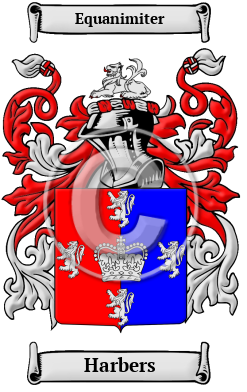
| ![Show Contents]() Harbers History, Family Crest & Coats of Arms Harbers History, Family Crest & Coats of Arms
- Origins Available:
England
Etymology of HarbersWhat does the name Harbers mean? The founding heritage of the Harbers family is in the Anglo-Saxon culture that once dominated in Britain. The name Harbers comes from when one of the family worked as a person who ran a lodging house. This surname is a metonymic form of the surname Harberer, and is derived from the Old English word herebeorg, which means shelter or lodging. 1 Early Origins of the Harbers familyThe surname Harbers was first found in Cambridgeshire where the Hundredorum Rolls of 1273 list Geoffrey Herbour and John Herbour as holding lands there at that time. 2 Two early London records show William le Herber in the Rotuli Litterarum Clausarum in Turri Londinesi; and Richard le Hareber in the Munimenta Gildhallæ Londoniensis. 1 Early History of the Harbers familyThis web page shows only a small excerpt of our Harbers research. Another 124 words (9 lines of text) covering the years 1572, 1575, 1596, 1635, 1676, 1679, 1689, 1690, 1692 and 1785 are included under the topic Early Harbers History in all our PDF Extended History products and printed products wherever possible. Harbers Spelling VariationsThe first dictionaries that appeared in the last few hundred years did much to standardize the English language. Before that time, spelling variations in names were a common occurrence. The language was changing, incorporating pieces of other languages, and the spelling of names changed with it. Harbers has been spelled many different ways, including Arbour, Arbor, Harbord, Harbard, Hardboard, Harboard, Harber, Harbot and many more. Early Notables of the Harbers familyWilliam Harbord (1635-1692), of Grafton Park, an English diplomat and politician, Privy Counsellor and Paymaster of the Forces in Ireland in 1689, Vice-Treasurer of Ireland in 1690. He was the first English ambassador to Turkey, was son of William Harborne, esq...
Another 41 words (3 lines of text) are included under the topic Early Harbers Notables in all our PDF Extended History products and printed products wherever possible.
| Harbers migration to the United States | + |
Thousands of English families in this era began to emigrate the New World in search of land and freedom from religious and political persecution. Although the passage was expensive and the ships were dark, crowded, and unsafe, those who made the voyage safely were rewarded with opportunities unavailable to them in their homeland. Research into passenger and immigration lists has revealed some of the very first Harberss to arrive in North America:
Harbers Settlers in United States in the 19th Century- Claus H Harbers, who arrived in Charleston, South Carolina in 1835 3
- William H Harbers, aged 21, who landed in Charleston, South Carolina in 1839 3
- Gerh Herm Harbers, who arrived in Missouri in 1844 3
- Herman Harbers, aged 25, who landed in Baltimore, Maryland in 1848 3
- Claus Heinrich Harbers, who landed in America in 1860 3
| Contemporary Notables of the name Harbers (post 1700) | + |
- Scott Harbers, American Democratic Party politician, Delegate to Democratic National Convention from Texas, 1996 4
The motto was originally a war cry or slogan. Mottoes first began to be shown with arms in the 14th and 15th centuries, but were not in general use until the 17th century. Thus the oldest coats of arms generally do not include a motto. Mottoes seldom form part of the grant of arms: Under most heraldic authorities, a motto is an optional component of the coat of arms, and can be added to or changed at will; many families have chosen not to display a motto.
Motto: Equanimiter
Motto Translation: With equanimity.
- Bardsley, C.W, A Dictionary of English and Welsh Surnames: With Special American Instances. Wiltshire: Heraldry Today, 1901. Print. (ISBN 0-900455-44-6)
- Reaney, P.H and R.M. Wilson, A Dictionary of English Surnames. London: Routledge, 1991. Print. (ISBN 0-415-05737-X)
- Filby, P. William, Meyer, Mary K., Passenger and immigration lists index : a guide to published arrival records of about 500,000 passengers who came to the United States and Canada in the seventeenth, eighteenth, and nineteenth centuries. 1982-1985 Cumulated Supplements in Four Volumes Detroit, Mich. : Gale Research Co., 1985, Print (ISBN 0-8103-1795-8)
- The Political Graveyard: Alphabetical Name Index. (Retrieved 2016, January 29) . Retrieved from http://politicalgraveyard.com/alpha/index.html
 |