![Show Contents]() Gunce History, Family Crest & Coats of Arms Gunce History, Family Crest & Coats of Arms
- Origins Available:
Scotland
Ireland
Etymology of GunceWhat does the name Gunce mean? The descendents of Viking settlers in ancient Scotland were the first to use the name Gunce. It was derived from Gunni, a descendant of Einar and of the great peace Kings of Uppsale in Sweden, progenitor of this great Clan. Gunni was the son of Gillanders, one of the six northern Earls who besieged King Malcolm IV of Scotland at Perth in 1160. The Gunns, the Sinclairs, the Mackays and the Gordons ruled the far northern reaches of Scotland. The Gunns' territory centered in Caithness and Sutherland. Early Origins of the Gunce familyThe surname Gunce was first found in the Orkneys. But perhaps to North Americans the most interesting aspect of Gunn history is the discovery of a Coat of Arms, which is undoubtedly of the Gunn Clan, in Westford, Massachusetts. Chiseled into a rock face, it has been reliably dated back to 1395. This was almost one hundred years before Columbus discovered America. Archaeologists first assumed this marking was the work of an early Indian tribe, but closer examination and the clearance of the scrub, revealed a knight in full armor, a huge sword and a shield on which the Gunn Coat of Arms was displayed. How did a Knight of the Gunn Clan manage to be buried in Massachusetts years before Columbus discovered America? For the answer, historians went back to the Orkneys. They knew that the Jarls of Orkney, many centuries before had recorded that they wintered in their Viking missions in a land running with fire from the rocks (Nova Scotia, also on the east coast of North America, has bituminous rocks, which can catch fire and melt down the ravines to the sea). They also knew that the Gunns were related to and rode and sailed with the Jarls of Orkney. The pieces of the puzzle fit together fine, but few historians had realized to that point that the Viking discoveries of the New World had penetrated as far south as Massachusetts. This carving is one of the few real evidences of their pioneering expeditions. It is also the earliest record of a Gunn Clan Coat of Arms. Early History of the Gunce familyThis web page shows only a small excerpt of our Gunce research. Another 152 words (11 lines of text) covering the years 1231, 1438, 1732, 1740, 1753 and 1890 are included under the topic Early Gunce History in all our PDF Extended History products and printed products wherever possible. Gunce Spelling VariationsIntuition and sound were the primary sources medieval scribes used to judge appropriate spellings and translations for names. The spelling of a name thus varied according to who was doing the recording. The different spelling variations of Gunce include Gunn, Gun, Guinne (Gaelic) and others. Early Notables of the Gunce familyAnother 50 words (4 lines of text) are included under the topic Early Gunce Notables in all our PDF Extended History products and printed products wherever possible. Migration of the Gunce family to IrelandSome of the Gunce family moved to Ireland, but this topic is not covered in this excerpt.
Another 66 words (5 lines of text) about their life in Ireland is included in all our PDF Extended History products and printed products wherever possible. Migration of the Gunce familyIn their new home, Scots found land and opportunity, and some even fought for their new freedom in the American War of Independence. Some, who remained loyal to the crown went north to Canada as United Empire Loyalists. In this century, the ancestors of both of these groups have begun recovering their illustrious national heritage through Clan societies and other Scottish historical organizations. Early immigration and passenger lists indicate many people bearing the Gunce name: Daniel Gunn who settled in Boston in 1651; John Gunn settled in Virginia in 1654; William Gunn settled in Jamaica in 1651; John Gunn settled in Nevis in 1654..
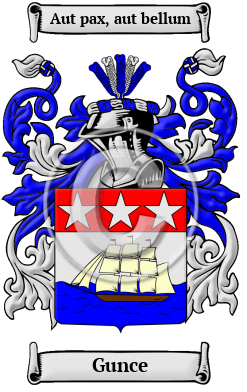
The motto was originally a war cry or slogan. Mottoes first began to be shown with arms in the 14th and 15th centuries, but were not in general use until the 17th century. Thus the oldest coats of arms generally do not include a motto. Mottoes seldom form part of the grant of arms: Under most heraldic authorities, a motto is an optional component of the coat of arms, and can be added to or changed at will; many families have chosen not to display a motto.
Motto: Aut pax, aut bellum
Motto Translation: Either peace or war
 |