| ![Show Contents]() Greear History, Family Crest & Coats of Arms Greear History, Family Crest & Coats of Arms
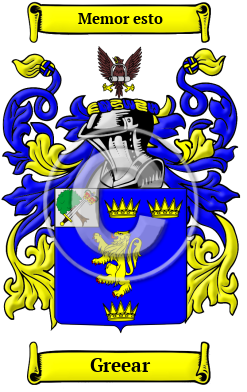
Etymology of GreearWhat does the name Greear mean? On the Scottish west coast, the Greear family was born among the ancient Dalriadan clans. Their name comes from the given name Gregor. The personal name Gregor, which is the Scottish form of Gregory, is derived from the Latin name "Gregorius" and from the Late Greek name "Gregorios," which mean alert, watchful, or vigilant. The name is "generally considered to be a shortened form of Macgregor." 1 Early Origins of the Greear familyThe surname Greear was first found in Dumfriesshire (Gaelic: Siorrachd Dhùn Phris), a Southern area, bordering on England that today forms part of the Dumfries and Galloway Council Area, where they held a family seat from very ancient times. The coat of arms for the family includes the coat of arms for King Donald MacAlpin (d. 864), King of Alban, the United Kingdom of the Scots and Picts in the top left of the shield. It denotes the heritage of the family through the MacGregors. Early History of the Greear familyThis web page shows only a small excerpt of our Greear research. Another 110 words (8 lines of text) covering the years 1542, 1598, 1669, 1754, 1780, 1831 and 1890 are included under the topic Early Greear History in all our PDF Extended History products and printed products wherever possible. Greear Spelling VariationsIn various documents Greear has been spelled Since medieval scribes still spelled according to sound, records from that era contain an enormous number of spelling variations. Greer, Grier, Grear, Grerar, Greir, Greerr, Grearr and many more. Early Notables of the Greear familyAnother 49 words (4 lines of text) are included under the topic Early Greear Notables in all our PDF Extended History products and printed products wherever possible. Greear RankingIn the United States, the name Greear is the 11,542nd most popular surname with an estimated 2,487 people with that name. 2 Migration of the Greear family to IrelandSome of the Greear family moved to Ireland, but this topic is not covered in this excerpt.
Another 165 words (12 lines of text) about their life in Ireland is included in all our PDF Extended History products and printed products wherever possible.
| Greear migration to the United States | + |
Significant portions of the populations of both the United States and Canada are still made up of the ancestors of Dalriadan families. Some of those in Canada originally settled the United States, but went north as United Empire Loyalists in the American War of Independence. The late 19th and early 20th centuries saw the ancestors of many Scots on both sides of the border begin to recover their collective national heritage through Clan societies and highland games. Some of the first North American settlers carried this name or one of its variants:
Greear Settlers in United States in the 19th Century- R. T. Greear, aged 26, who arrived in America, in 1895
Greear Settlers in United States in the 20th Century- Robert Greear, aged 49, who arrived in America, in 1909
- Cathanna Greear, aged 45, who arrived in America, in 1909
- Gertrude Greear, aged 22, who arrived in America, in 1909
- Thomas Greear, aged 19, who arrived in America, in 1920
| Contemporary Notables of the name Greear (post 1700) | + |
- Mary Elizabeth Greear (1914-2002), birth name of Joan Barclay, an American film actress of the 1930s and 1940s
- Mike Greear, American politician, Member of the Wyoming House of Representatives (2011-)
- J.D. Greear Ph.D. (b. 1937), Lead Pastor at the Summit Church of Raleigh-Durham, North Carolina
- John F. Greear, American politician, Member of Virginia State Senate 6th District, 1904-07 3
- Dan Greear, American Republican politician, Alternate Delegate to Republican National Convention from West Virginia, 2008 4
The motto was originally a war cry or slogan. Mottoes first began to be shown with arms in the 14th and 15th centuries, but were not in general use until the 17th century. Thus the oldest coats of arms generally do not include a motto. Mottoes seldom form part of the grant of arms: Under most heraldic authorities, a motto is an optional component of the coat of arms, and can be added to or changed at will; many families have chosen not to display a motto.
Motto: Memor esto
Motto Translation: Be mindful.
- Black, George F., The Surnames of Scotland Their Origin, Meaning and History. New York: New York Public Library, 1946. Print. (ISBN 0-87104-172-3)
- "What are the 5,000 Most Common Last Names in the U.S.?". NameCensus.com, https://namecensus.com/last-names/
- The Political Graveyard: Alphabetical Name Index. (Retrieved 2015, November 11) . Retrieved from http://politicalgraveyard.com/alpha/index.html
 |