| ![Show Contents]() Graces History, Family Crest & Coats of Arms Graces History, Family Crest & Coats of Arms
Etymology of GracesWhat does the name Graces mean? The surname Graces is generally thought to derive from the Old French word "grace," which means "charm" or "pleasantness." In some instances, it may have evolved from the Old French word "gros," which means "great," or "large." In either instance, the name was a nickname which evolved into a surname. Early Origins of the Graces familyThe surname Graces was first found in Normandy where "Raymond Fitz-William de Carew, surnamed ' Crassus,' 'Le Gros,' and ' Le Gras,' accompanied Strongbow, Earl of Pembroke, in his celebrated expedition into Ireland in 1169, and he may be regarded 'as the Achilles of the enterprise.' He married Basilia de Clare, Strongbow's sister, with whom he acquired an enormous estate in Killarney, subsequently known as 'the Cantred of Grace's country;' for 'his cognomen Gros, given him on account of his prowess, gradually became first Gras, and then by English pronunciation Grace.' Many of the English families of this name deduce their descent from Ireland." 1 "The Irish family of Grace appears to be a branch of the Fitzgeralds. For the Baronets Grace, see Gammon." 2 "The Norman family of Grace has been prominent in Irish history since the first le Gros came to Ireland with Strongbow." 3 Early History of the Graces familyThis web page shows only a small excerpt of our Graces research. Another 92 words (7 lines of text) covering the years 1172, 1559, 1620, 1652, 1689 and 1691 are included under the topic Early Graces History in all our PDF Extended History products and printed products wherever possible. Graces Spelling VariationsChurch officials and medieval scribes often spelled early surnames as they sounded. This practice often resulted in many spelling variations of even a single name. Early versions of the name Graces included: Grace, Grase and others. Early Notables of the Graces familySir Oliver Grace, Knight of Ballylinch and Legan Castles, County Kilkenny, Lord of Carney, Tipperary, and Member of Parliament for that county in 1559; and his son, Oliver Grace, of Shanganagh, (now Gracefield), Member of Parliament for the borough of Ballynakill in 1689
Richard Grace (1620?-1691), was Governor of Athlone, "a younger son...
Another 52 words (4 lines of text) are included under the topic Early Graces Notables in all our PDF Extended History products and printed products wherever possible. Migration of the Graces familyIreland experienced a dramatic decrease in its population during the 19th century. This was in a great measure, a response to England's imperialistic policies. Hunger and disease took the lives of many Irish people and many more chose to leave their homeland to escape the horrific conditions. North America with its promise of work, freedom, and land was an extremely popular destination for Irish families. For those families that survived the journey, all three of these things were often attained through much hard work and perseverance. Research into early immigration and passenger lists revealed many immigrants bearing the name Graces: Martin Grace who resided in St. John's, Newfoundland, in 1803; Oliver Grace from County Carlow was married at St. John's, Newfoundland in 1810.
The motto was originally a war cry or slogan. Mottoes first began to be shown with arms in the 14th and 15th centuries, but were not in general use until the 17th century. Thus the oldest coats of arms generally do not include a motto. Mottoes seldom form part of the grant of arms: Under most heraldic authorities, a motto is an optional component of the coat of arms, and can be added to or changed at will; many families have chosen not to display a motto.
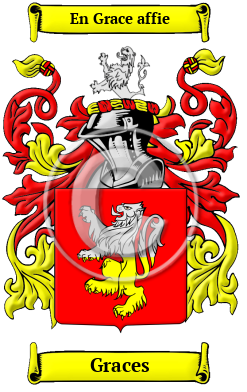
Motto: En Grace affie
Motto Translation: On Grace, depend.
- Lower, Mark Anthony, Patronymica Britannica, A Dictionary of Family Names of the United Kingdom. London: John Russel Smith, 1860. Print.
- The Norman People and Their Existing Descendants in the British Dominions and the United States Of America. Baltimore: Genealogical Publishing, 1975. Print. (ISBN 0-8063-0636-X)
- MacLysaght, Edward, More Irish Families. Dublin: Irish Academic Press, 1982. Print. (ISBN 0-7165-0126-0)
 |