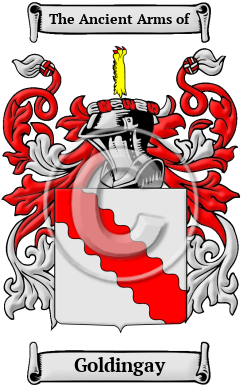
| ![Show Contents]() Goldingay History, Family Crest & Coats of Arms Goldingay History, Family Crest & Coats of Arms
- Origins Available:
England
Early Origins of the Goldingay familyThe surname Goldingay was first found in Essex where they held a family seat as Lords of the Manor. After the Battle of Hastings in 1066, William, Duke of Normandy, having prevailed over King Harold, granted most of Britain to his many victorious Barons. It was not uncommon to find a Baron, or a Bishop, with 60 or more Lordships scattered throughout the country. These he gave to his sons, nephews and other junior lines of his family and they became known as under-tenants. They adopted the Norman system of surnames which identified the under-tenant with his holdings so as to distinguish him from the senior stem of the family. After many rebellious wars between his Barons, Duke William, commissioned a census of all England to determine in 1086, settling once and for all, who held which land. He called the census the Domesday Book, 1 indicating that those holders registered would hold the land until the end of time. Hence, conjecturally, the surname is descended from the tenant of the lands of Goldingham, held by Hubert, under tenant from Robert Malet, a Norman Baron of Graville, said to be one of the most imposing figures at the Conquest, who was recorded in the Domesday Book census of 1086. Goldingham held 5 beehives and 260 sheep. Goldingham Hall, the manor house, is noteworthy. There is a Goldingham Farm at Braintree in the same county. Early History of the Goldingay familyThis web page shows only a small excerpt of our Goldingay research. Another 70 words (5 lines of text) covering the years 1206, 1273 and 1285 are included under the topic Early Goldingay History in all our PDF Extended History products and printed products wherever possible. Goldingay Spelling VariationsSpelling variations of this family name include: Goldingham, Coldingham, Goldenham, Gouldingham and many more. Early Notables of the Goldingay familyMore information is included under the topic Early Goldingay Notables in all our PDF Extended History products and printed products wherever possible.
| Goldingay migration to Australia | + |
Emigration to Australia included the First Fleet of convicts, tradespeople and early settlers. Early immigrants include: First Fleet - Mr. John Goldingay, (b. 1751), aged 38, British settler convicted in Warwickshire, England in 1788, sentenced to 7 years for stealing, transported aboard the ship "Neptune, Scarborough or Surprize" leaving in 1789 arriving in New South Wales, Australia in 1790 2
Following the First Fleet, other convicts and early settlers arriving in Australia include: Goldingay Settlers in Australia in the 19th Century- Mr. William Goldingay, (b. 1783), aged 17, English baker who was convicted in Warwick, Warwickshire, England for 7 years, transported aboard the "Earl Cornwallis" in August 1800, arriving in New South Wales, Australia 3
- Mr. William Goldingay, English agricultural labourer who was convicted in Warwick, Warwickshire, England for life for stealing, transported aboard the "Coromandel" on 25th June 1838, arriving in Tasmania (Van Diemen's Land) 4
- Williams, Dr Ann. And G.H. Martin, Eds., Domesday Book A Complete Translation. London: Penguin, 1992. Print. (ISBN 0-141-00523-8)
- Convict Records of Australia. Retrieved 4th February 2021 from https://convictrecords.com.au/ships
- Convict Records Voyages to Australia (Retrieved 13th August 2021). Retrieved from https://convictrecords.com.au/ships/earl-cornwallis
- Convict Records Voyages to Australia (Retrieved 19th March 2021). Retrieved from https://convictrecords.com.au/ships/coromandel
 |