| ![Show Contents]() Garety History, Family Crest & Coats of Arms Garety History, Family Crest & Coats of Arms
- Origins Available:
Ireland
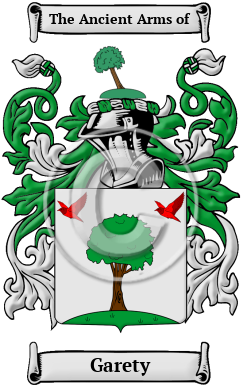
Etymology of GaretyWhat does the name Garety mean? The Irish name Garety was originally written in a Gaelic form as Mag Oireachtaigh, which is derived from the word "oireachtach," referring to a member of an assembly. Translating the name into English produces no less than seventeen different synonyms. But the origin of the name is most intriguing. In the 12th century, the name was simply Ó Roduibh but a Oireachtach Ó Roduibh at that time caused the name to be shortened to Oireachtach, their present form. 1 Early Origins of the Garety familyThe surname Garety was first found in counties Roscommon and Galway (Irish: Gaillimh) part of the province of Connacht, located on the west coast of the Island, where they were one of the Hi Maine Septs in Kelly's country. They were direct descendants of the O'Connors, Kings of Connacht, and the Chief of the Clann was one of the four royal chiefs under the O'Connor. (O'Hart) The tree on the Coat of Arms illustrates their descendancy from the O'Connors. Early History of the Garety familyThis web page shows only a small excerpt of our Garety research. Another 78 words (6 lines of text) covering the years 1300, 1585, 1598 and 1744 are included under the topic Early Garety History in all our PDF Extended History products and printed products wherever possible. Garety Spelling VariationsThose scribes in Ireland during the Middle Ages recorded names as they sounded. Consequently, in this era many people were recorded under different spellings each time their name was written down. Research on the Garety family name revealed numerous spelling variations, including Gerrity, Gerty, Gerighty, Gerighaty, Gerety, Gerahty, Garraty, Geraty, Jerety, McGerity, MacGeraghty, MacGartie, MacGarty and many more. Early Notables of the Garety familyAnother 29 words (2 lines of text) are included under the topic Early Garety Notables in all our PDF Extended History products and printed products wherever possible.
| Garety migration to the United States | + |
To escape the religious and political discrimination they experienced primarily at the hands of the English, thousands of Irish left their homeland in the 19th century. These migrants typically settled in communities throughout the East Coast of North America, but also joined the wagon trains moving out to the Midwest. Ironically, when the American War of Independence began, many Irish settlers took the side of England, and at the war's conclusion moved north to Canada. These United Empire Loyalists, were granted land along the St. Lawrence River and the Niagara Peninsula. Other Irish immigrants settled in Newfoundland, the Ottawa Valley, New Brunswick and Nova Scotia. The greatest influx of Irish immigrants, however, came to North America during the Great Potato Famine of the late 1840s. Thousands left Ireland at this time for North America and Australia. Many of those numbers, however, did not live through the long sea passage. These Irish settlers to North America were immediately put to work building railroads, coal mines, bridges, and canals. Irish settlers made an inestimable contribution to the building of the New World. Early North American immigration records have revealed a number of people bearing the Irish name Garety or a variant listed above, including:
Garety Settlers in United States in the 19th Century- Thomas Garety, who arrived in New York, NY in 1836 2
- MacLysaght, Edward, Irish Families Their Names, Arms and Origins 4th Edition. Dublin: Irish Academic, 1982. Print. (ISBN 0-7165-2364-7)
- Filby, P. William, Meyer, Mary K., Passenger and immigration lists index : a guide to published arrival records of about 500,000 passengers who came to the United States and Canada in the seventeenth, eighteenth, and nineteenth centuries. 1982-1985 Cumulated Supplements in Four Volumes Detroit, Mich. : Gale Research Co., 1985, Print (ISBN 0-8103-1795-8)
 |