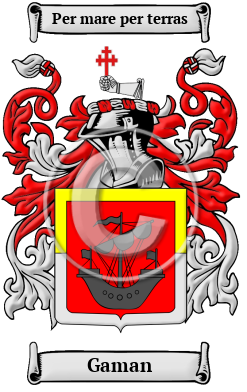
| ![Show Contents]() Gaman History, Family Crest & Coats of Arms Gaman History, Family Crest & Coats of Arms
Etymology of GamanWhat does the name Gaman mean? The Gaman family comes from the ancient Scottish Dalriadan clans of the mountainous west coast of Scotland. The name Gaman is derived from person who was skilled in the riding of horses or who owned many horses. The Gaelic form of the name was Mac Eachthighearna, which translates as son of the horse-lord. 1 Early Origins of the Gaman familyThe surname Gaman was first found in Kintyre, where "on the shaft of the cross at Kilkerran near Campbeltown, is the inscription: Hec est: crvx: Coleni: Mc: Heachyrna: et Katirine: uxoris: eivs (Drummond, Sculptured monuments of Iona, pl. lxxxi). This is probably Colin MacEachern who was chief of the Macecherns in 1499." 1 Early History of the Gaman familyThis web page shows only a small excerpt of our Gaman research. Another 188 words (13 lines of text) covering the years 1499, 1505, 1506, 1507, 1512, 1515, 1541, 1596, 1605, 1647, 1659, 1662, 1682, 1684, 1694, 1769, 1788, 1798, 1801, 1806, 1814, 1818, 1847, 1849 and 1888 are included under the topic Early Gaman History in all our PDF Extended History products and printed products wherever possible. Gaman Spelling VariationsSpelling variations were extremely common in medieval names, since scribes from that era recorded names according to sound rather than a standard set of rules. Gaman has appeared in various documents spelled MacEachern, MacEachen, MacEachan, MacEachin, MacEachren and many more. Early Notables of the Gaman familyEvan MacEachen (1769-1849), Gaelic scholar, born at Arisaig, Invernessshire, in 1769, was educated in a school at Ruthven, near Keith. He was sent in 1788 to the Scots College at Valladolid, where he was ordained priest in 1798. On his return to the mission he was stationed at Arisaig. In 1801 he was removed to Badenoch, and thence was sent, about 1806, in the...
Another 63 words (4 lines of text) are included under the topic Early Gaman Notables in all our PDF Extended History products and printed products wherever possible. Migration of the Gaman family to IrelandSome of the Gaman family moved to Ireland, but this topic is not covered in this excerpt.
Another 39 words (3 lines of text) about their life in Ireland is included in all our PDF Extended History products and printed products wherever possible. Migration of the Gaman familyDalriadan families proliferated in North America. Their descendants still populate many communities in the eastern parts of both the United States and Canada. Some settled in Canada as United Empire Loyalists, in the wake of the American War of Independence. Families on both sides of the border have recovered much of their heritage in the 20th century through Clan societies and highland games. Analysis of immigration records indicates that some of the first North American immigrants bore the name Gaman or a variant listed above: Archibald MacEachern and his wife Jean, who settled in New York State with the children in 1738; Donald MacEachern and his wife Anne settled with his child in New York State in 1738.
The motto was originally a war cry or slogan. Mottoes first began to be shown with arms in the 14th and 15th centuries, but were not in general use until the 17th century. Thus the oldest coats of arms generally do not include a motto. Mottoes seldom form part of the grant of arms: Under most heraldic authorities, a motto is an optional component of the coat of arms, and can be added to or changed at will; many families have chosen not to display a motto.
Motto: Per mare per terras
Motto Translation: By sea and by land.
- Black, George F., The Surnames of Scotland Their Origin, Meaning and History. New York: New York Public Library, 1946. Print. (ISBN 0-87104-172-3)
 |