| ![Show Contents]() Galantry History, Family Crest & Coats of Arms Galantry History, Family Crest & Coats of Arms
- Origins Available:
Scotland
Etymology of GalantryWhat does the name Galantry mean? The ancestors of the Galantry family were part of an ancient Scottish tribe called the Picts. They lived in some place which is now obscure. The surname Galantry belongs to the category of habitation names, which are derived from pre-existing names for towns, villages, parishes, or farmsteads. 1 Other sources claim the name is "a nickname for messenger, runner, 2 or "a messenger or runner [who] was fleet of foot." 3 Early Origins of the Galantry familyThe surname Galantry was first found in Perthshire (Gaelic: Siorrachd Pheairt) former county in the present day Council Area of Perth and Kinross, located in central Scotland, where they held a family seat from very ancient times, some say well before the Norman Conquest and the arrival of Duke William at Hastings in 1066 A.D. Early History of the Galantry familyThis web page shows only a small excerpt of our Galantry research. Another 79 words (6 lines of text) covering the years 1291, 1296, 1745, 1762, 1784 and 1789 are included under the topic Early Galantry History in all our PDF Extended History products and printed products wherever possible. Galantry Spelling VariationsPrior to the invention of the printing press in the last hundred years, documents were basically unique. Names were written according to sound, and often appeared differently each time they were recorded. Spelling variations of the name Galantry include Galletly, Gallightly, Gellatly, Gellately, Gillatly, Golightly and many more. Early Notables of the Galantry familyAnne Catleyborn, born in 1745 in an alley near "Tower Hill, London of very humble parents, her father being a hackney coachman, and her mother a washerwoman. Endowed with great personal beauty, a charming voice, and a natural talent for singing, she gained her living at the early age of 10 years by singing in the public houses in the neighbourhood, and also for the diversion of the officers quartered in the Tower. When about 15 years of age she was apprenticed by her father to William Bates for...
Another 88 words (6 lines of text) are included under the topic Early Galantry Notables in all our PDF Extended History products and printed products wherever possible. Migration of the Galantry familyThe freedom of the North American colonies was enticing, and many Scots left to make the great crossing. It was a long and hard journey, but its reward was a place where there was more land than people and tolerance was far easier to come by. Many of these people came together to fight for a new nation in the American War of Independence, while others remained loyal to the old order as United Empire Loyalists. The ancestors of Scots in North America have recovered much of this heritage in the 20th century through Clan societies and other such organizations. A search of immigration and passenger lists revealed many important and early immigrants to North America bearing the name of Galantry: Stephen Gallatly who settled in Boston Massachusetts in 1823.
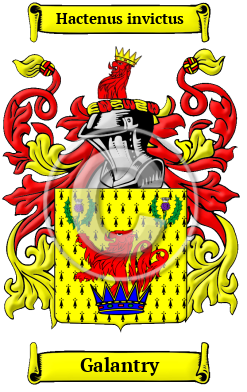
The motto was originally a war cry or slogan. Mottoes first began to be shown with arms in the 14th and 15th centuries, but were not in general use until the 17th century. Thus the oldest coats of arms generally do not include a motto. Mottoes seldom form part of the grant of arms: Under most heraldic authorities, a motto is an optional component of the coat of arms, and can be added to or changed at will; many families have chosen not to display a motto.
Motto: Hactenus invictus
Motto Translation: Hitherto unconquered.
- Lower, Mark Anthony, Patronymica Britannica, A Dictionary of Family Names of the United Kingdom. London: John Russel Smith, 1860. Print.
- Harrison, Henry, Surnames of the United Kingdom: A Concise Etymological Dictionary Baltimore: Geneological Publishing Company, 2013. Print
- Smith, Eldson Coles, New Dictionary of American Family Names New York: Harper & Row, 1956. Print
 |