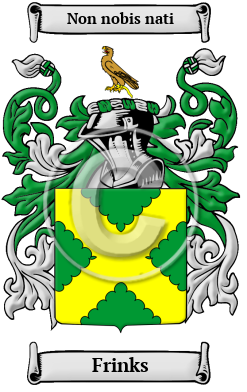
| ![Show Contents]() Frinks History, Family Crest & Coats of Arms Frinks History, Family Crest & Coats of Arms
Etymology of FrinksWhat does the name Frinks mean? Frinks is a name of Anglo-Saxon origin. It was a name given to a person who was referred to as being free or generous. The surname was originally derived from the Old French franc, which meant "liberal, generous." In this case, the name would have been initially bestowed as a nickname either on someone who was generous or in an ironic way on someone who was stingy. The surname also has origins from the Norman official title, the frank which also means free. To confuse matters more, the surname could have been derived from the Norman personal name "Franc," which was originally an ethnic name for one of Frankish race. Early Origins of the Frinks familyThe surname Frinks was first found in the Domesday Book where bearers of the name Frinks were granted lands in Shropshire, Yorkshire, Norfolk, and Surrey. The name appears with some frequency in various counties between the 11th and 14th centuries; early bearers of the name include Ricardus filius Franke, who was living in London in 1188, and Ricardus Franc, who was listed in the Curia Regis Rolls of Essex in 1201. 1 Early History of the Frinks familyThis web page shows only a small excerpt of our Frinks research. Another 86 words (6 lines of text) covering the years 1273, 1613, 1624, 1640, 1664, 1708 and 1775 are included under the topic Early Frinks History in all our PDF Extended History products and printed products wherever possible. Frinks Spelling VariationsBefore the last few hundred years, the English language had no fast system of spelling rules. For that reason, spelling variations are commonly found in early Anglo-Saxon surnames. Over the years, many variations of the name Frinks were recorded, including Frank, Franks, Franke, Frankes, Frenk, Frink and many more. Early Notables of the Frinks familyMark Frank (1613-1664), a British theologian, Master of Pembroke College, Cambridge; John Frank (c.1640), a British bookseller; Calvin Frink (c.1775), a British army surgeon; and Richard Franck (1624?-1708), an English captain in the Parliamentary Army and author from Nottingham. He was born and educated at Cambridge, but probably was not a member of the university. "When the civil war...
Another 58 words (4 lines of text) are included under the topic Early Frinks Notables in all our PDF Extended History products and printed products wherever possible. Migration of the Frinks family to IrelandSome of the Frinks family moved to Ireland, but this topic is not covered in this excerpt. More information about their life in Ireland is included in all our PDF Extended History products and printed products wherever possible.
| Frinks migration to the United States | + |
To escape oppression and starvation at that time, many English families left for the "open frontiers" of the New World with all its perceived opportunities. In droves people migrated to the many British colonies, those in North America in particular, paying high rates for passages in cramped, unsafe ships. Although many of the settlers did not make the long passage alive, those who did see the shores of North America perceived great opportunities before them. Many of the families that came from England went on to make essential contributions to the emerging nations of Canada and the United States. Research into various historical records revealed some of first members of the Frinks family emigrate to North America:
Frinks Settlers in United States in the 19th Century- B J Frinks, aged 23, who arrived in Key West, Fla in 1838 2
The motto was originally a war cry or slogan. Mottoes first began to be shown with arms in the 14th and 15th centuries, but were not in general use until the 17th century. Thus the oldest coats of arms generally do not include a motto. Mottoes seldom form part of the grant of arms: Under most heraldic authorities, a motto is an optional component of the coat of arms, and can be added to or changed at will; many families have chosen not to display a motto.
Motto: Non nobis nati
Motto Translation: Born not for ourselves
- Reaney, P.H and R.M. Wilson, A Dictionary of English Surnames. London: Routledge, 1991. Print. (ISBN 0-415-05737-X)
- Filby, P. William, Meyer, Mary K., Passenger and immigration lists index : a guide to published arrival records of about 500,000 passengers who came to the United States and Canada in the seventeenth, eighteenth, and nineteenth centuries. 1982-1985 Cumulated Supplements in Four Volumes Detroit, Mich. : Gale Research Co., 1985, Print (ISBN 0-8103-1795-8)
 |