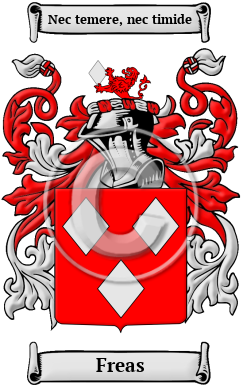
| ![Show Contents]() Freas History, Family Crest & Coats of Arms Freas History, Family Crest & Coats of Arms
Etymology of FreasWhat does the name Freas mean? When the Strongbownians began to settle in Ireland, they initially ignored the established Gaelic system for developing of patronymic names and solely relied on their own traditional naming practices. Eventually, however, the two differing customs drew upon one another to some degree. The Strongbow settlers, unlike their Gaelic neighbors, frequently used nickname surnames. These Anglo-Norman nicknames were frequently of two types: "oath names" and "imperative names." Oath names often carried blessings or were formed from habitual expressions. Imperative names, formed from a verb added to a noun or an adverb, metaphorically described the bearer's occupations. The nick name surname Freas is derived from a nickname for a free-born man. The surname Freas is derived from the Old English words "freomann" and "frigmann," which both mean freeman. The surname Freas is also used as an Anglicized version of Mac an tSaoir, which means son of the craftsman. Early Origins of the Freas familyThe surname Freas was first found in County Cork (Irish: Corcaigh) the ancient Kingdom of Deis Muin (Desmond), located on the southwest coast of Ireland in the province of Munster, where they were granted lands by Strongbow after the invasion of Ireland in 1172. Early History of the Freas familyThis web page shows only a small excerpt of our Freas research. Another 140 words (10 lines of text) covering the years 1150, 1172, 1296, 1301, 1690 and 1926 are included under the topic Early Freas History in all our PDF Extended History products and printed products wherever possible. Freas Spelling VariationsChurch officials and medieval scribes spelled names as they sounded; therefore, single person, could have his name spelt many different ways during their lifetime. While investigating the origins of the name Freas, many spelling variations were encountered, including: Freeman, Freman and others. Early Notables of the Freas familyMore information is included under the topic Early Freas Notables in all our PDF Extended History products and printed products wherever possible.
| Freas migration to the United States | + |
A great number of Irish families left their homeland in the late 18th century and throughout the 19th century, migrating to such far away lands as Australia and North America. The early settlers left after much planning and deliberation. They were generally well off but they desired a tract of land that they could farm solely for themselves. The great mass of immigrants to arrive on North American shores in the 1840s differed greatly from their predecessors because many of them were utterly destitute, selling all they had to gain a passage on a ship or having their way paid by a philanthropic society. These Irish people were trying to escape the aftermath of the Great Potato Famine: poverty, starvation, disease, and, for many, ultimately death. Those that arrived on North American shores were not warmly welcomed by the established population, but they were vital to the rapid development of the industry, agriculture, and infrastructure of the infant nations of the United States and what would become Canada. Early passenger and immigration lists reveal many Irish settlers bearing the name Freas:
Freas Settlers in United States in the 19th Century- Yost Henry Freas, who arrived in Maryland in 1810 1
The motto was originally a war cry or slogan. Mottoes first began to be shown with arms in the 14th and 15th centuries, but were not in general use until the 17th century. Thus the oldest coats of arms generally do not include a motto. Mottoes seldom form part of the grant of arms: Under most heraldic authorities, a motto is an optional component of the coat of arms, and can be added to or changed at will; many families have chosen not to display a motto.
Motto: Nec temere, nec timide
Motto Translation: Neither rashly nor timidly.
- Filby, P. William, Meyer, Mary K., Passenger and immigration lists index : a guide to published arrival records of about 500,000 passengers who came to the United States and Canada in the seventeenth, eighteenth, and nineteenth centuries. 1982-1985 Cumulated Supplements in Four Volumes Detroit, Mich. : Gale Research Co., 1985, Print (ISBN 0-8103-1795-8)
 |