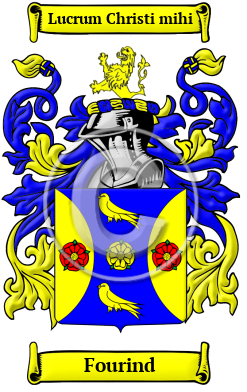
Hundreds of years ago, the Gaelic name used by the Fourind family in Ireland was Ó Fuarain or in some records Ó Furanain.
Loading...
Early Origins of the Fourind family
The surname Fourind was first found in Connacht (Irish: Connachta, (land of the) descendants of Conn), where they were firstly known as Macgiollarnath or Mac Gilla na Naomh, meaning 'son of the devotee of the saints', which, through mistranslation and time emerged as an off-shoot of the main Clan through a chieftain O'Fuarthain or O'Fuarain, which, in English, became Fourind.
Early History of the Fourind family
This web page shows only a small excerpt of our Fourind research. Another 142 words (10 lines of text) covering the years 1172, 1355 and 1816 are included under the topic Early Fourind History in all our PDF Extended History products and printed products wherever possible.
Fourind Spelling Variations
The recording of names in Ireland during the Middle Ages was an inconsistent endeavor at best. Since the general population did not know how to read or write, they could only specify how their names should be recorded orally. Research into the name Fourind revealed spelling variations, including Foran, Forhane, Forahan, Forhan, Foreham and many more.
Early Notables of the Fourind family
More information is included under the topic Early Fourind Notables in all our PDF Extended History products and printed products wherever possible.
Loading...
Loading...
Loading...
Loading...
Migration of the Fourind family
In the 19th century, thousands of Irish left their English-occupied homeland for North America. Like most new world settlers, the Irish initially settled on the eastern shores of the continent but began to move westward with the promise of owning land. The height of this Irish migration came during the Great Potato Famine of the late 1840s. With apparently nothing to lose, Irish people left on ships bound for North America and Australia. Unfortunately a great many of these passengers lost their lives - the only thing many had left - to disease, starvation, and accidents during the long and dangerous journey. Those who did safely arrive in "the land of opportunities" were often used for the hard labor of building railroads, coal mines, bridges, and canals. The Irish were critical to the quick development of the infrastructure of the United States and Canada. Passenger and immigration lists indicate that members of the Fourind family came to North America quite early: Jno Forehead, who came to Virginia in 1653; Gillian Forehand, who arrived in Maryland in 1671; John Foran who settled in New York State in 1804;Patrick Forehan was a merchant in St. John'.
The motto was originally a war cry or slogan. Mottoes first began to be shown with arms in the 14th and 15th centuries, but were not in general use until the 17th century. Thus the oldest coats of arms generally do not include a motto. Mottoes seldom form part of the grant of arms: Under most heraldic authorities, a motto is an optional component of the coat of arms, and can be added to or changed at will; many families have chosen not to display a motto.
Motto: Lucrum Christi mihi Motto Translation: Without Christ, there is no light.
Remove Item
WARNING!
Removing this item from your shopping cart will remove your associated sale items.
Are you sure you want to delete this item from your shopping cart?
HouseofNames E-Newsletter Sign Up
On Demand Gifts | Digital Products Available 24/7
A Gift for Everyone on your List is a Click Away - Shop Now