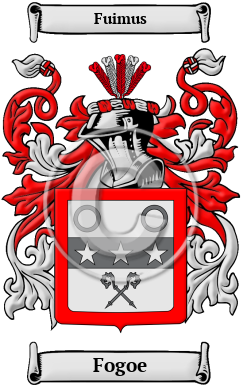
| ![Show Contents]() Fogoe History, Family Crest & Coats of Arms Fogoe History, Family Crest & Coats of Arms
Etymology of FogoeWhat does the name Fogoe mean? The name Fogo, the root name of all of its variants is distinctly Scottish, but interestingly the name is also Portuguese for the word "fire." In the New World, Fogo has lent its name to Fogo Island and the Town of Fogo, just off the northeast coast of Newfoundland. This fishing settlement and town dates back to at least 1606 when it appears on the Bertius Map. Early Origins of the Fogoe familyThe surname Fogoe was first found in north eastern England and southern Scotland, especially in Berwickshire where the family claims descent from the lands of Fogo. One of the first records of the family was Adam de Foghou who witnessed the gift by Earl Waldeve to the monks of Melrose of a pasture on Lammermuir (c. 1166-1182.) Fogo Priory was a Tironensian monastic community in Berwickshire, dedicated to St Nicholas, founded sometime between 1253 and 1297. Later, William de Foghou was abbot of Melrose in 1310 and Master Richard of Foggowe, parson of Douglas, had letters of safe conduct through England in 1352. John de Fogo appears as abbot of Melrose in 1425 and confessor to King James I in 1436. Robert de Fogo was bachelor of decrees in Glasgow in 1438 and Andrew Fogo was member of an assize at Cupar in 1521. 1 Early History of the Fogoe familyThis web page shows only a small excerpt of our Fogoe research. Another 120 words (9 lines of text) covering the years 1425, 1438, 1553, 1554, 1609 and 1652 are included under the topic Early Fogoe History in all our PDF Extended History products and printed products wherever possible. Fogoe Spelling VariationsThe name Fogoe, appeared in many references, and from time to time, the surname was spelt Foggowe, Foggow, Foggoe, Fogoe, Fogo, Foggo and others. Early Notables of the Fogoe familyMore information is included under the topic Early Fogoe Notables in all our PDF Extended History products and printed products wherever possible. Migration of the Fogoe familyThe New World beckoned as many of the settlers in Ireland, known as the Scotch/Irish, became disenchanted. They sailed aboard the armada of sailing ships known as the "White Sails" which plied the stormy Atlantic. Some called them, less romantically, the "coffin ships." Amongst the early settlers who could be considered kinsmen of the Fogoe family, or who bore a variation of the surname Fogoe were David Fogo settled in Barbados in 1679.
The motto was originally a war cry or slogan. Mottoes first began to be shown with arms in the 14th and 15th centuries, but were not in general use until the 17th century. Thus the oldest coats of arms generally do not include a motto. Mottoes seldom form part of the grant of arms: Under most heraldic authorities, a motto is an optional component of the coat of arms, and can be added to or changed at will; many families have chosen not to display a motto.
Motto: Fuimus
Motto Translation: God and my country.
- Black, George F., The Surnames of Scotland Their Origin, Meaning and History. New York: New York Public Library, 1946. Print. (ISBN 0-87104-172-3)
 |